
In this post, we’ll review the Thypoch Simera 28 mm f/1.4 lens for the Leica M-Mount. I always get excited when a company introduces a new lens, but I also question what incremental value the lens will bring to the market, given the M-Mount’s long history and extensive lens choices, going back decades.
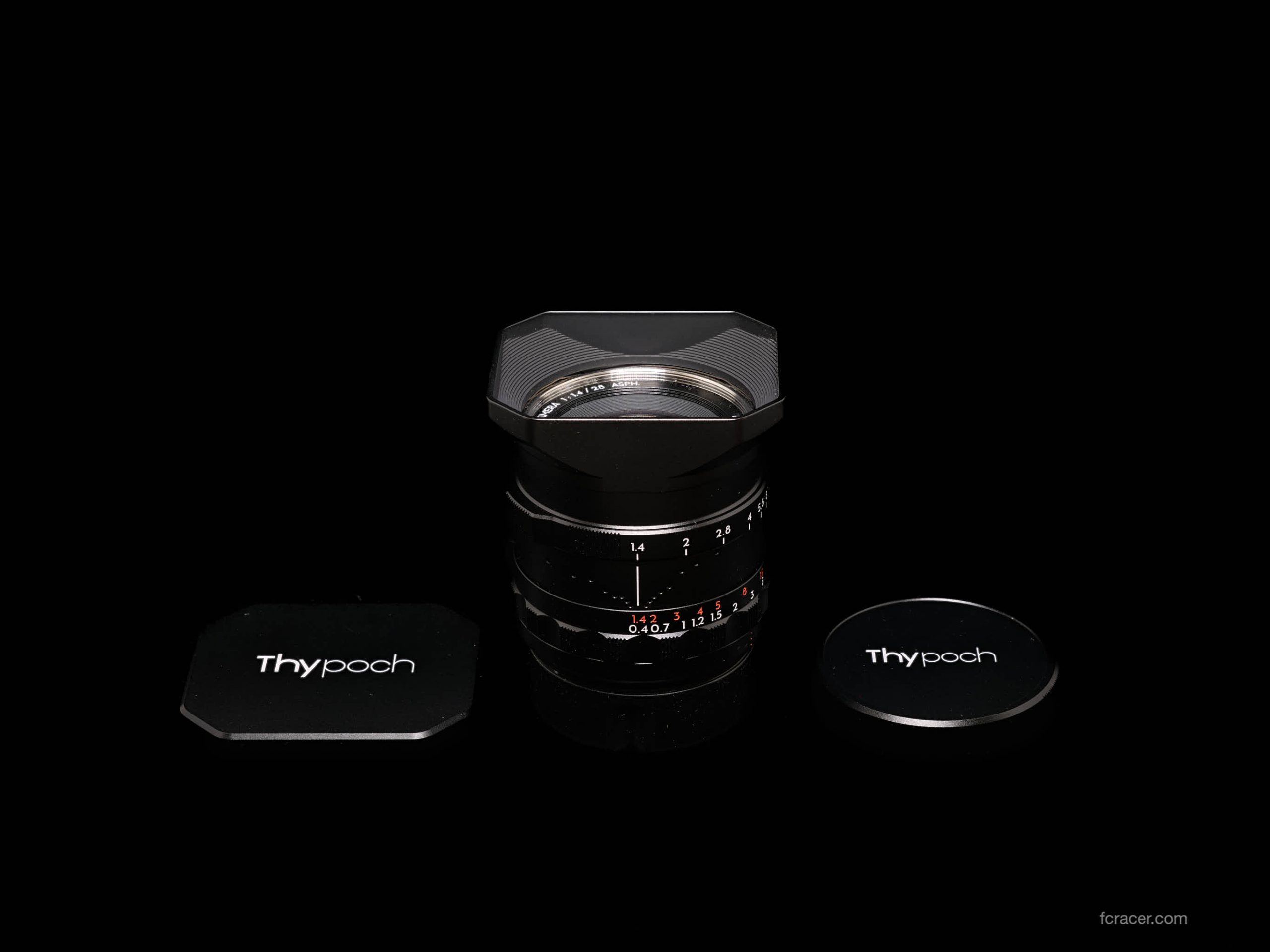
A 28 mm focal length invokes great memories from the early days of my Leica journey. The very first Leica I bought was the Q2, with its famous 28 mm f/1.4 lens. One of the magic tricks of that lens was its close focusing ability, something we’ll come back to later.
I paired the Thypoch 28 mm with the Leica M11, using the latest firmware. To keep track of which images were taken with this lens, I set the lens detection to mimic the Leica 28mm f/2.8 Elmarit. If the EXIF information shows this, that’s the reason why. Please also remember that the Leica M system takes an educated guess at aperture so they won’t always reflect the actual shooting aperture. Where important, I’ve provided the actual shooting aperture.

Disclaimer: This lens was provided by Thypoch for review. All opinions are my own with no external or third-party input. Images were edited with Capture One Pro and chosen to demonstrate a broad range of apertures and environments, rather than pure artistic value. Selected high-resolution images (~50MB) are available for download here.
Unboxing Experience
I don’t recall writing about an unboxing experience with my previous lens reviews, so you know this was something special. Thypoch clearly put a lot of thought into how this lens will present itself to its new owner. It felt more like opening a luxury watch box rather than a lens.
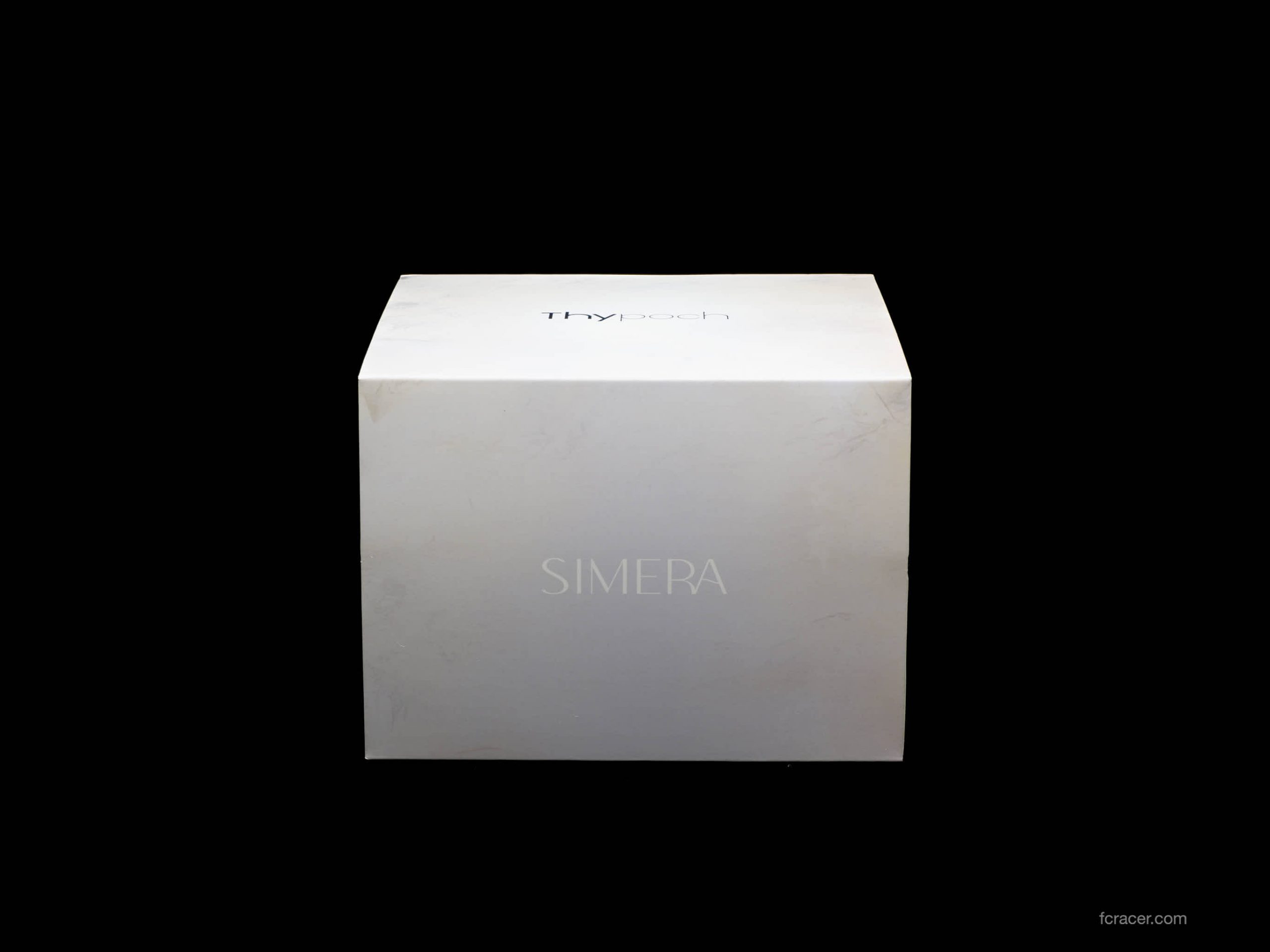
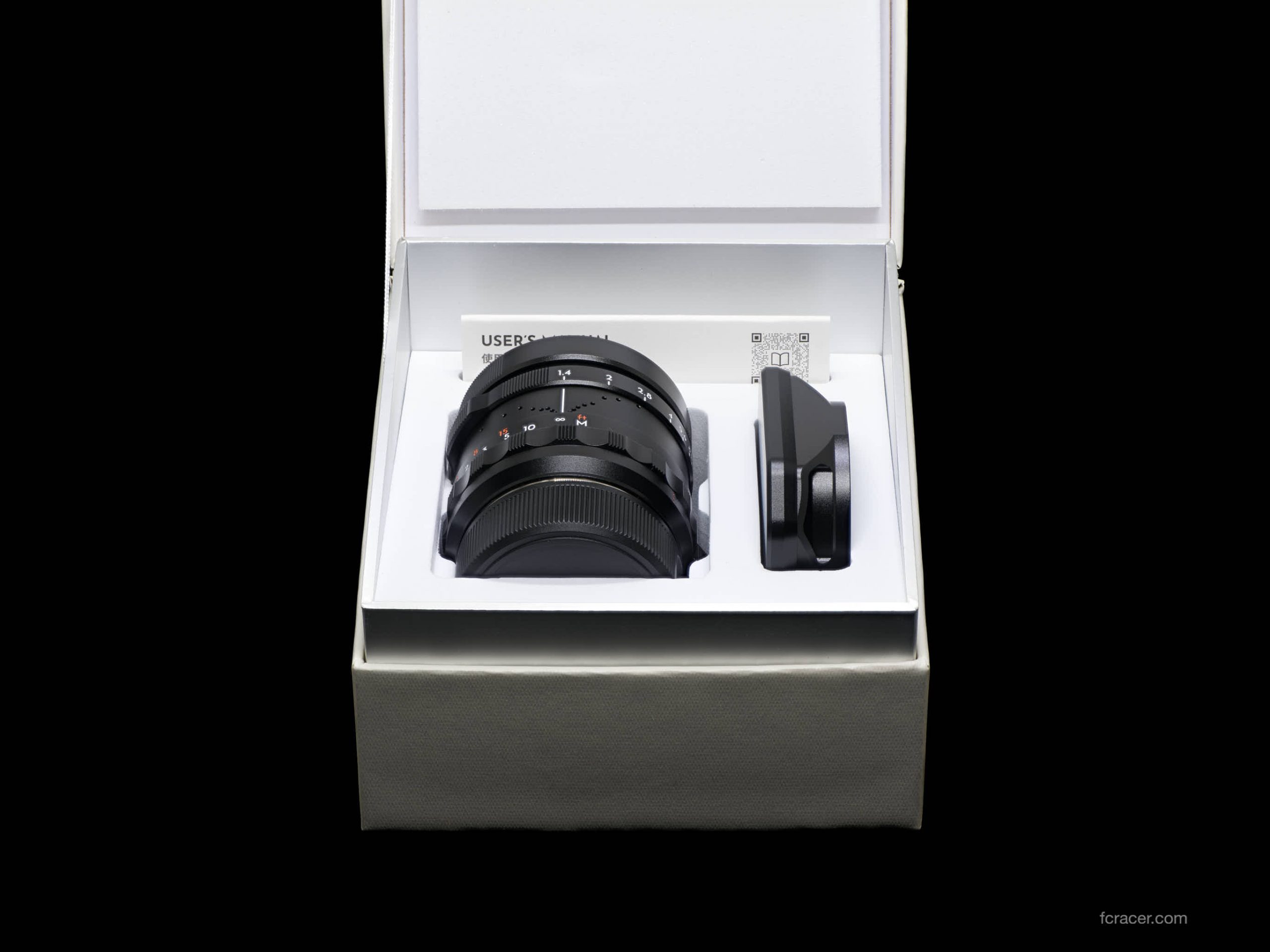
There’s an outer sleeve with a print that alludes to the lens’ character and intent. However, it’s the inner box that really impressed with its quality, design intent, and protection. The inner box opens like a watch box with a hinge. The lens, lens hood, lens cap, and instruction manual are perfectly placed in the protective foam while wrapped in protective plastic.
It feels special, and I love that the designers went to this much effort to make a great first impression.

Build Quality
That great first impression carries forward when extracting the lens from the box. It’s small for a wide-angle, wide-aperture lens, but it feels dense in the hand. There’s a sense of quality from the moment your hand touches the outer body. Taking a quick turn of the aperture dial confirms our first impressions with well-damped movements and a nice click. The focus tab has a similar feel, with it providing just the right amount of consistent resistance across the range.
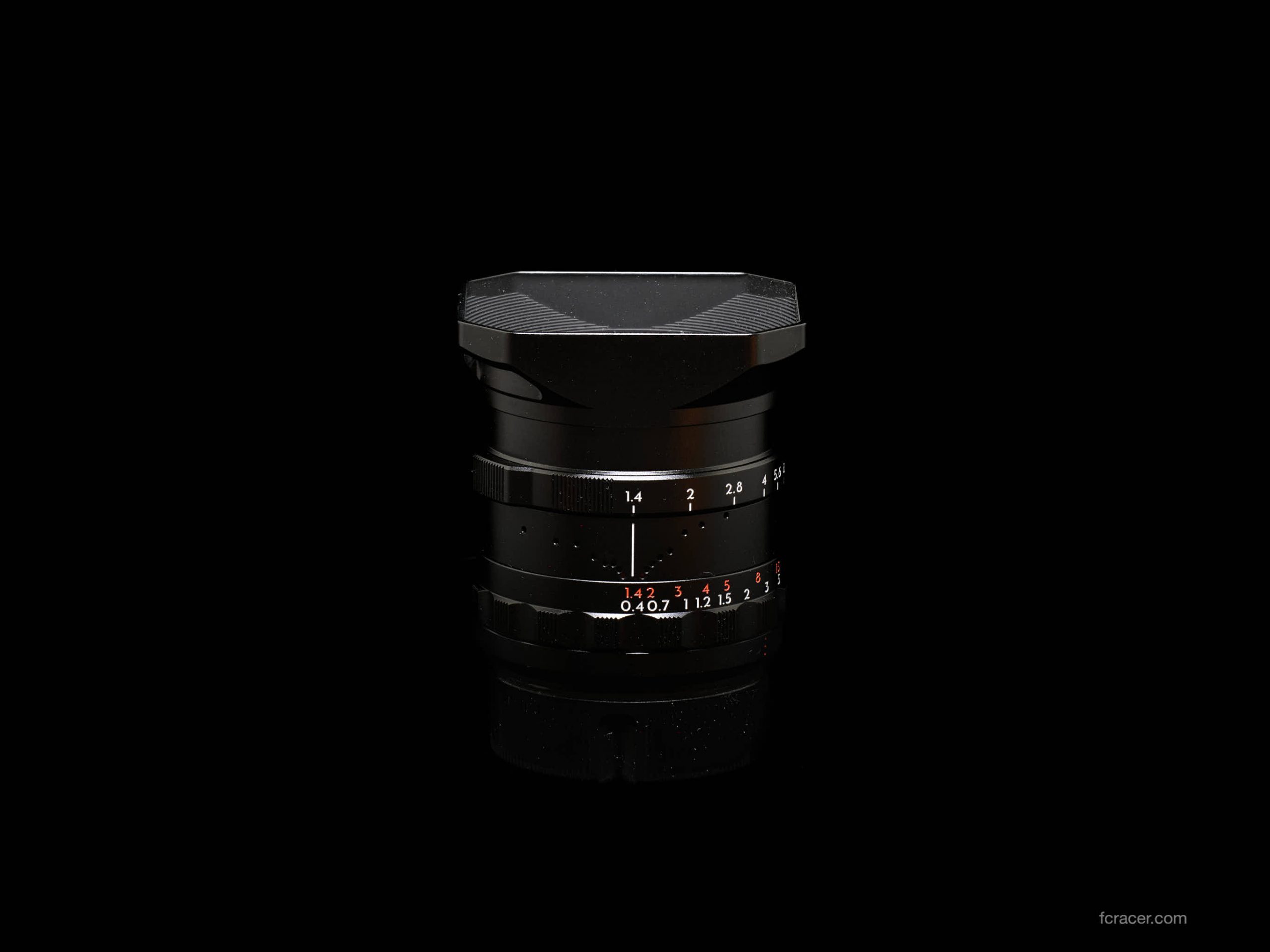
The body is all metal, with only the focus tab appearing to be plastic. Thypoch includes a beautiful metal square lens hood. I’m a huge fan of this style as you’ve likely read in my Fujifilm Square Hood post. While the hood is beautifully designed and looks great on the lens, the mounting system doesn’t match up to the rest of the lens’ engineering quality and precision. It goes on a bit rough and doesn’t have a lock; it just pushes up against a stop with friction keeping it in place.
For everyday use, the build quality is exceptional and right up there with Leica and Voigtländer, who are in my view, the M-Mount top-tier standard bearers. If you blindfolded me and handed me three recent lenses from Leica, Voigtländer, and Thypoch, I would have a hard time distinguishing them apart.

Size & Weight
The lens feels dense in the hand, due to its beautiful metal build, but when compared to its competitors, the Thypoch 28 mm is actually lighter and smaller. Here’s a comparison:
| Specification | Leica Summilux-M 28mm f/1.4 ASPH. | Thypoch Simera 28mm f/1.4 | Voigtländer Nokton 28mm f/1.5 ASPH. |
| Max Diameter | 61 mm | 54 mm | 54 mm |
| Length (from flange) | 81 mm | 55 mm | 45.5 mm |
| Filter Thread | 49 mm | 49 mm | 43 mm |
| Weight | 440 g (15.5 oz) | 330 g (11.6 oz) | 250 g (Type I) / 330 g (Type II) |
| Price | USD 8,555 | USD 669 | USD 999-1,049 |
The Thypoch 28 mm is significantly shorter and lighter than the Leica Summilux, a bit longer than the Voigtländer, but the same weight. It should be noted that the Voigtländer is an f/1.5 lens, whereas the Leica and Thypoch are both f/1.4.
With the lens hood on, the obstruction in the viewfinder was negligible. Without the hood, the view is of course even better. In my daily use, I didn’t find the lens or hood to come in the way of comfortable shooting.
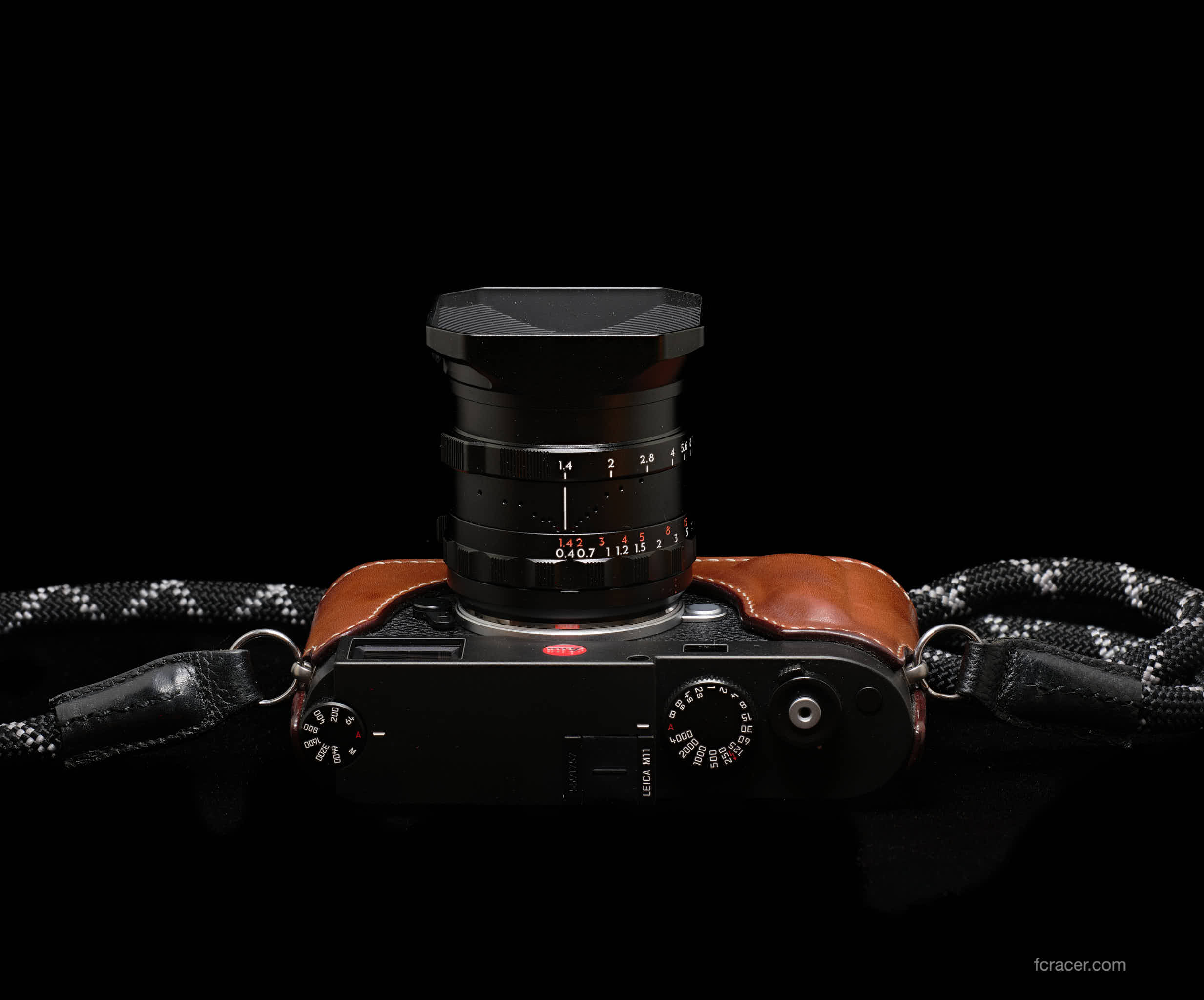
I love the way the Thypoch feels in the hand; it has that wonderful density you get with high-end Leica lenses, where you can feel the engineering and high-quality materials at your fingertips.
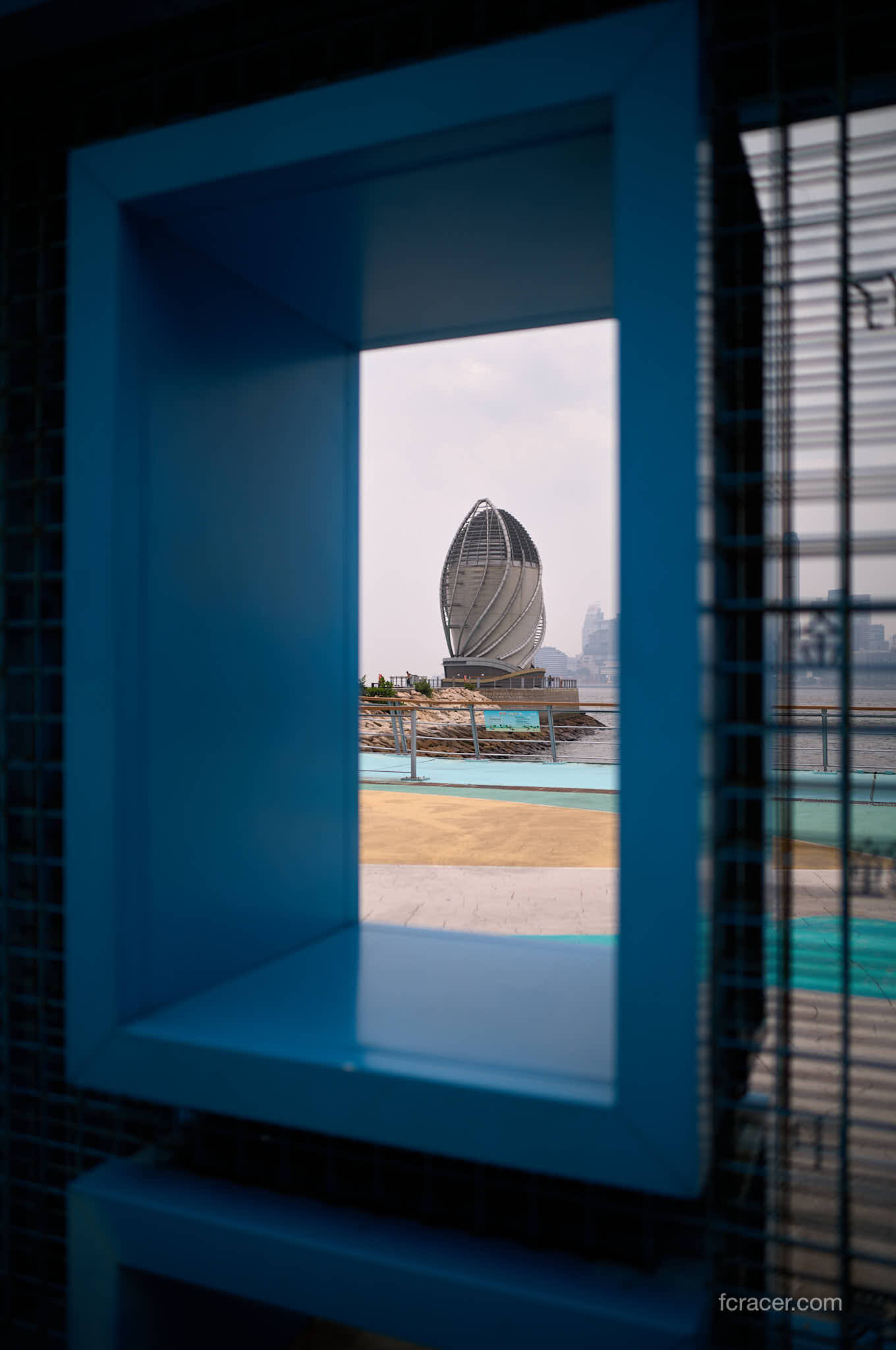
Contrast & Resolution
For this series of tests, we’ll start at the Minimum Focus Distance (MFD) of 30 cm and then repeat the test at infinity distance. In prior lens tests on the Leica M-Mount, I’ve found that the sharpness can vary significantly depending on the distance, with the MFD being the least sharp. I was especially interested in seeing how the Thypoch 28 mm performed given that it has a much closer MFD of 30 cm than the 70 cm that the Leica rangefinder is designed for. This would make the test even more challenging for the Thypoch 28 mm.

Minimum Focus Distance
Starting with the centre, we can see that the Thypoch 28 mm has very good sharpness even wide open at f/1.4. This was somewhat surprising given the lens’ small size; I fully expected there to be a softness to the image like the Leica 35mm Summilux f/1.4 has when wide open.
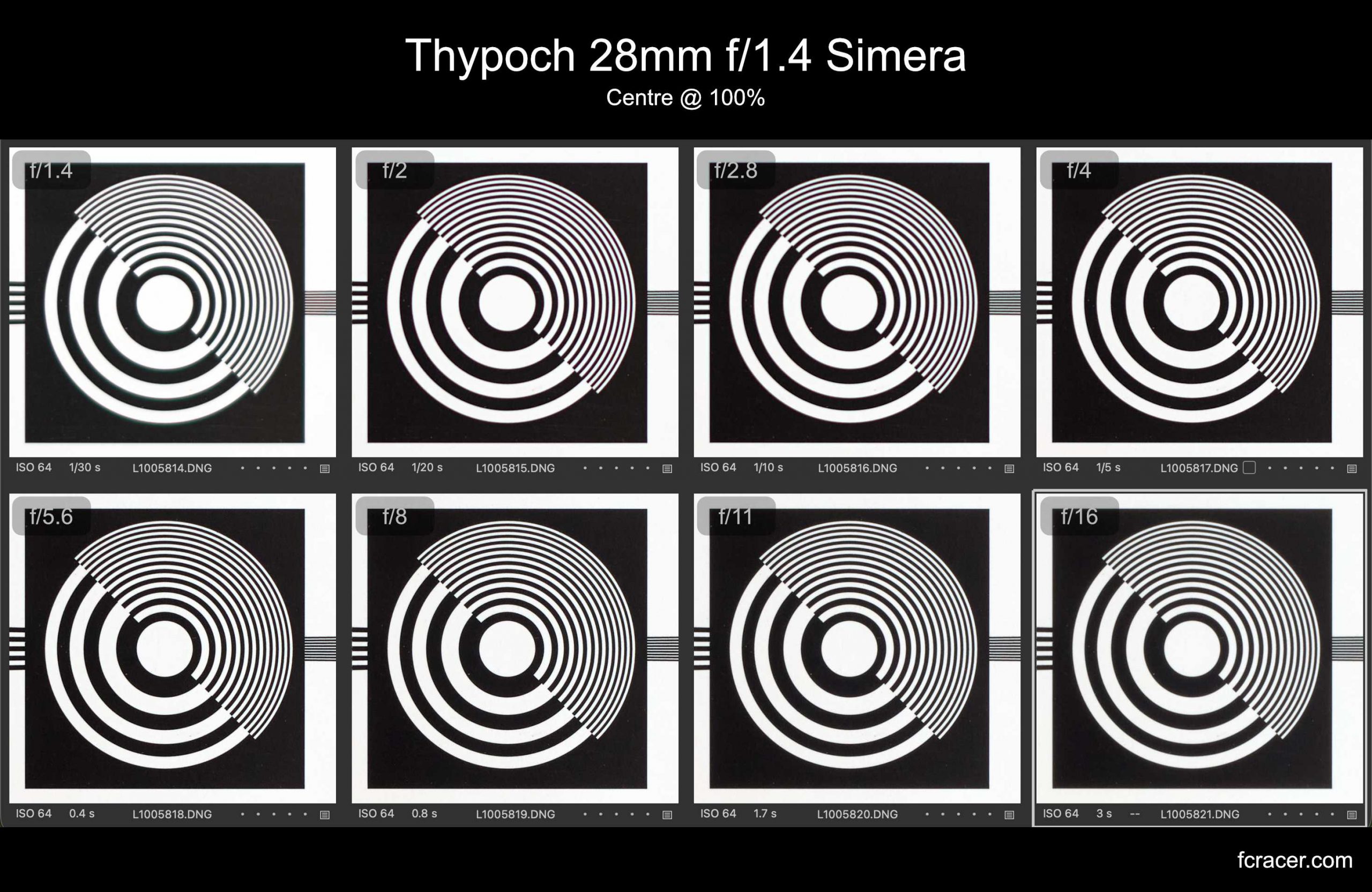
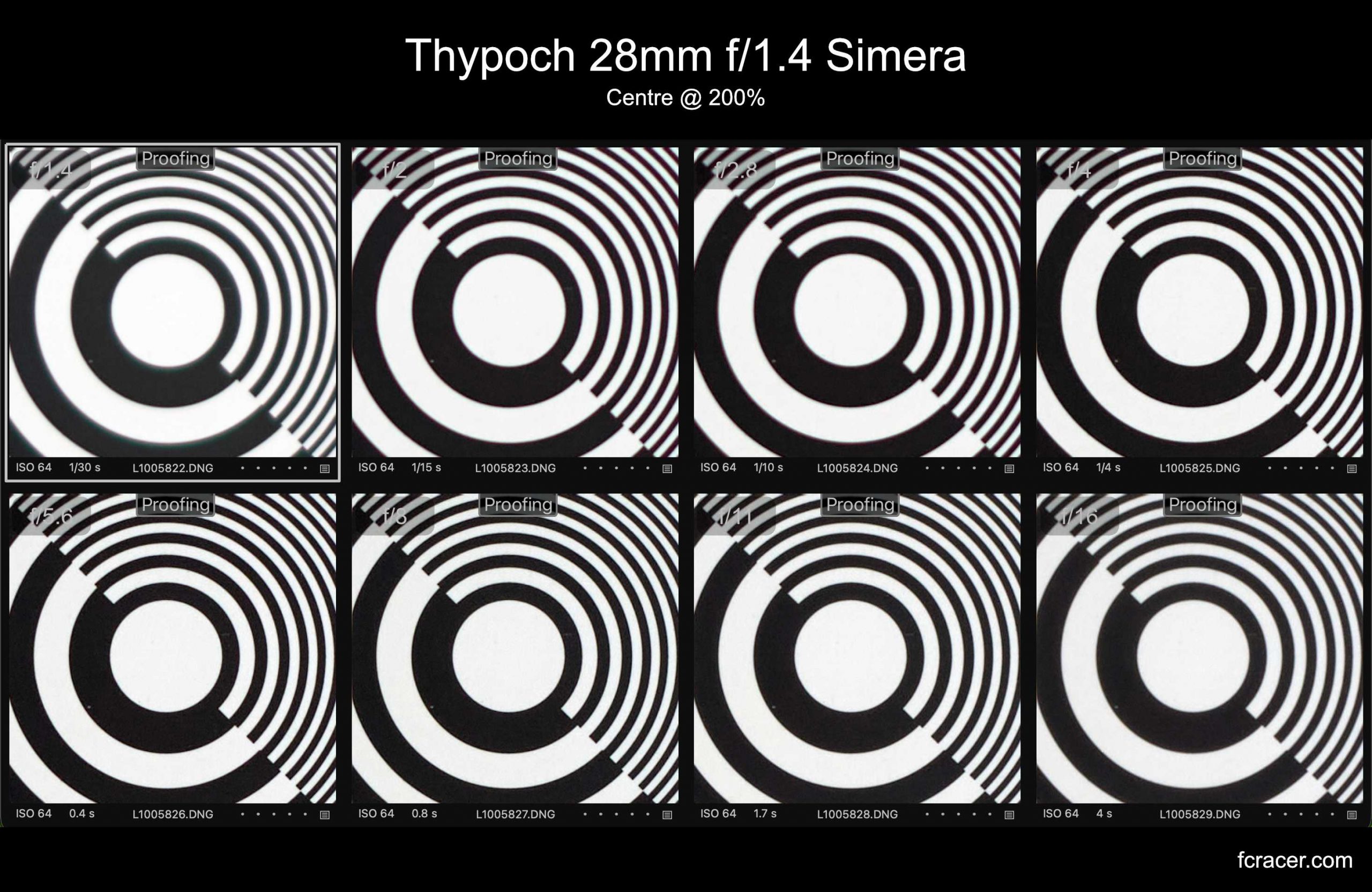
As the lens is stopped down, sharpness takes an immediate step up at f/2, with a noticeable increase in contrast and edge definition. This high level of sharpness remains until f/11. At f/16, diffraction comes into play and, as expected, softens the image.
Lenses made for Leica M-Mount often prioritize size (especially diameter) and weight over absolute optical quality. Furthermore, Leica owners tend to be less fussy about absolute sharpness and instead focus on other characteristics such as bokeh rendering.
Going to the very far edge, we can see where some minor compromise was made to prioritize the lens’ size and weight. There’s a softness from f/1.4 to f/2.8, and then a gradual improvement that becomes very good at f/4 and peaks at f/8-f/11.
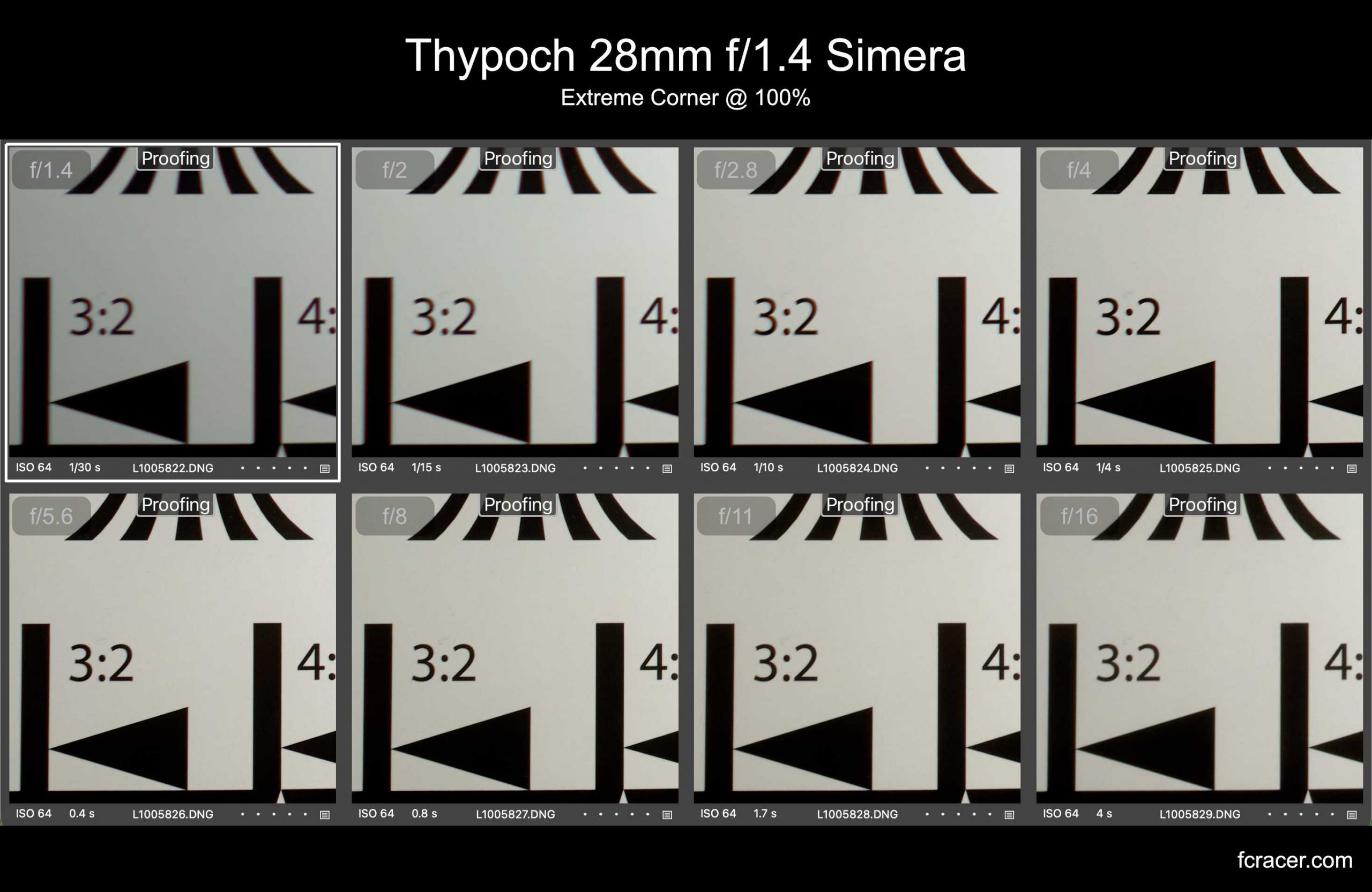
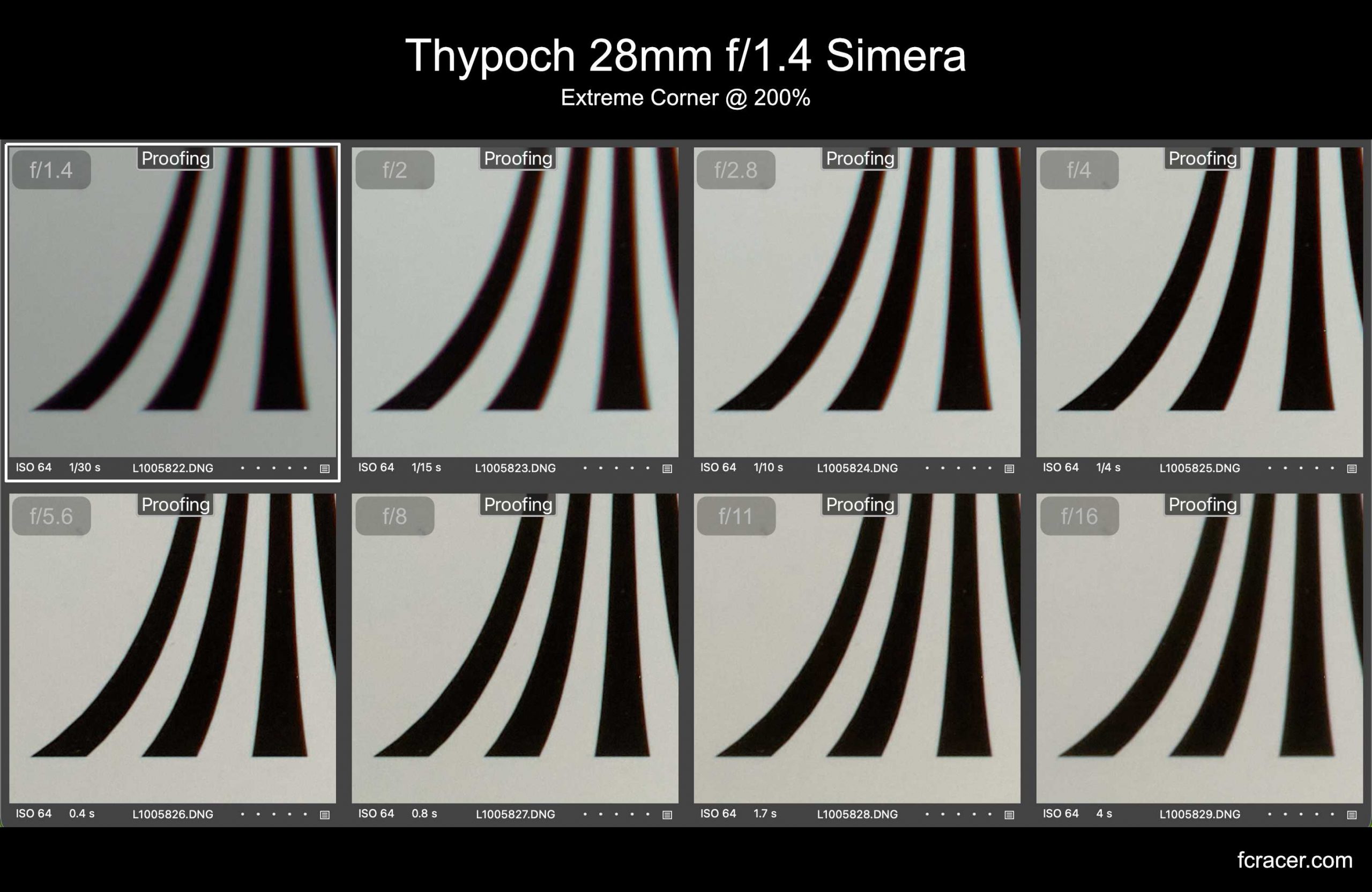
This is actually a very good performance as it happens to be at the Minimum Focus Distance (MFD) of 0.3 m. This level of performance is likely due to Thypoch’s use of a Floating Lens Element (FLE) in the design. It enables the lens to provide high resolution at both near and far distances.
Infinity Focus Distance
At infinity focus distance, we see the same pattern emerge. Very good sharpness at f/1.4 in the centre, with a major step up at f/2. This high level of sharpness stays consistent from f/2 to f/11.
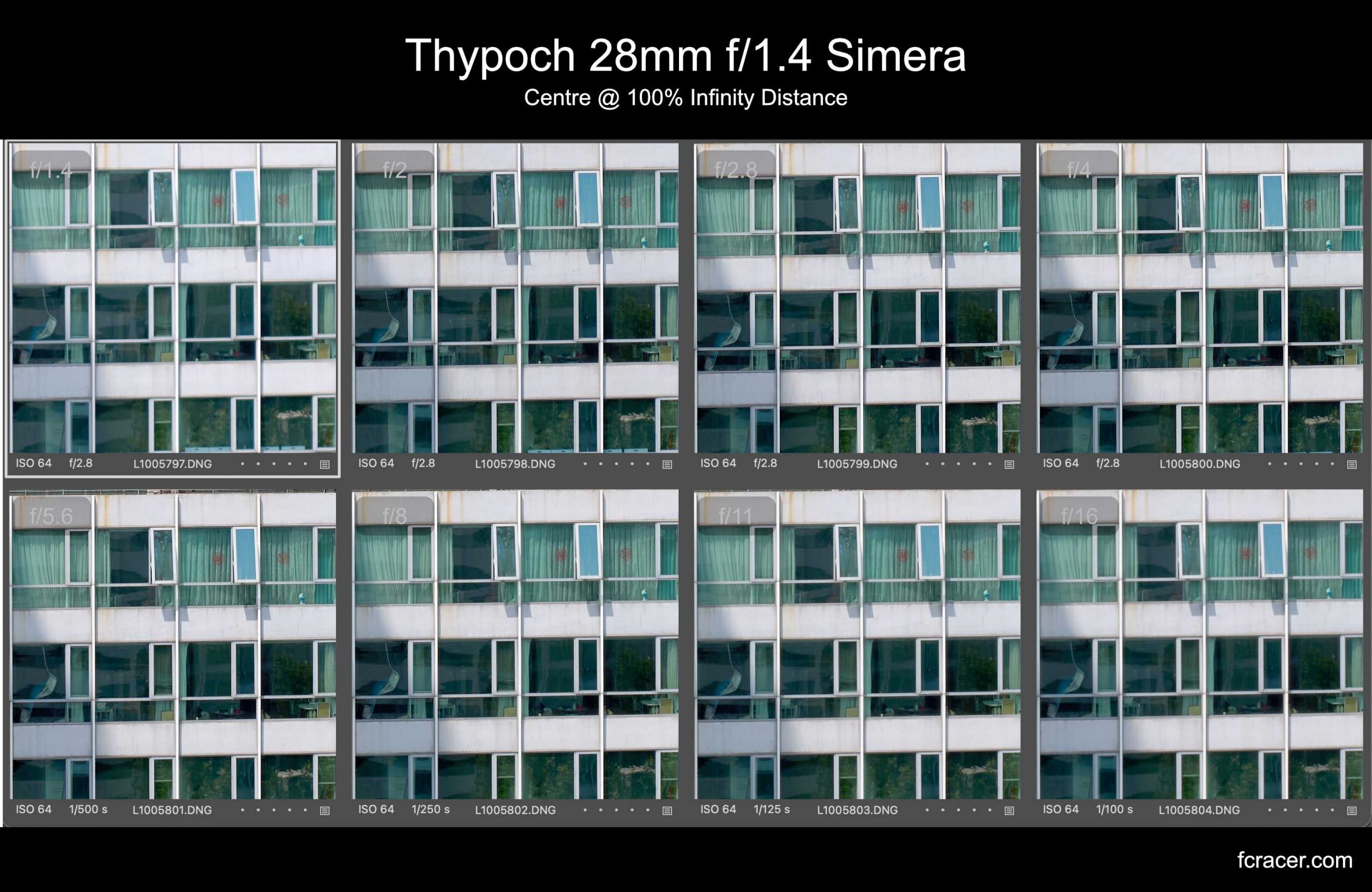
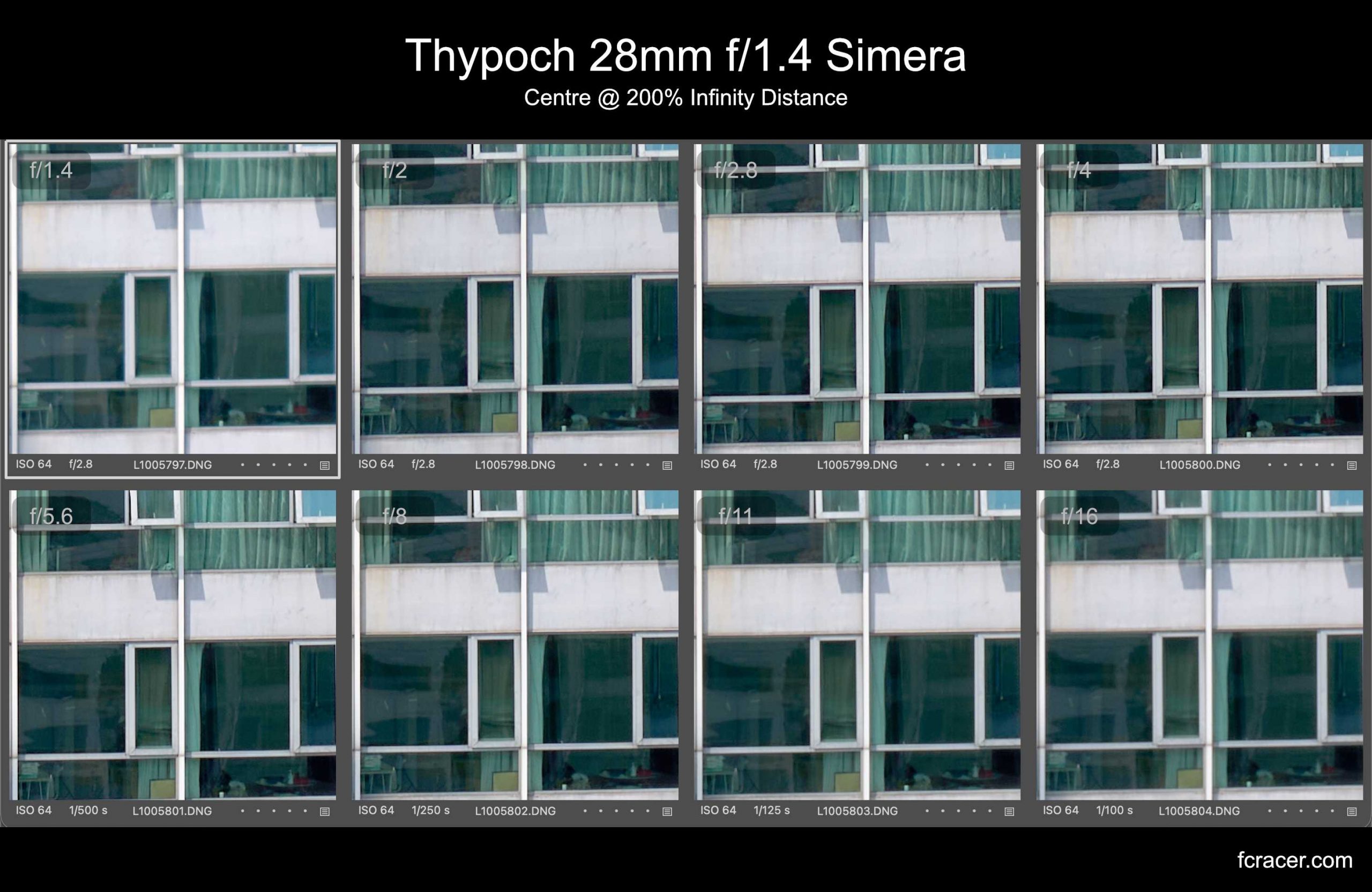
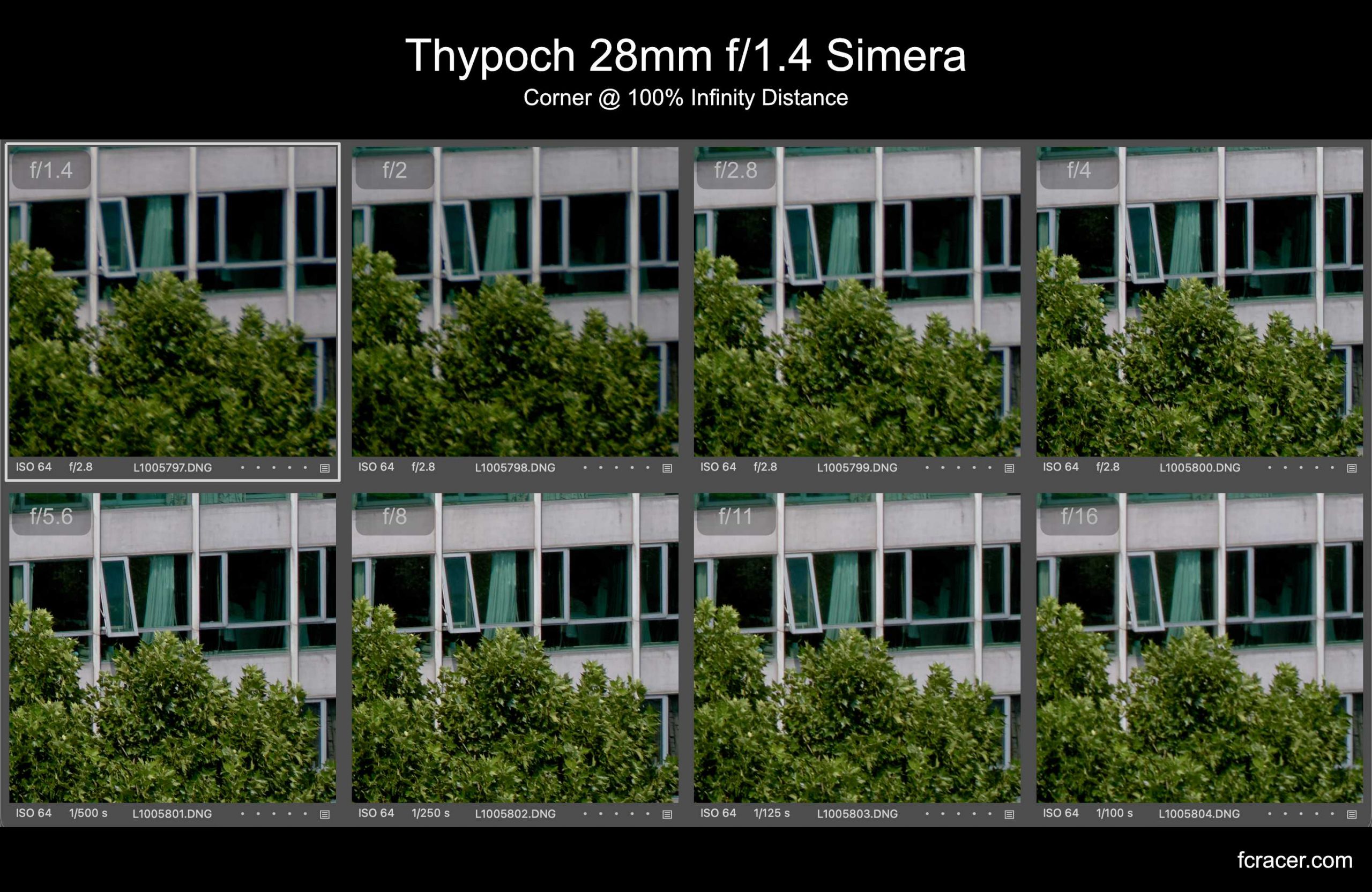
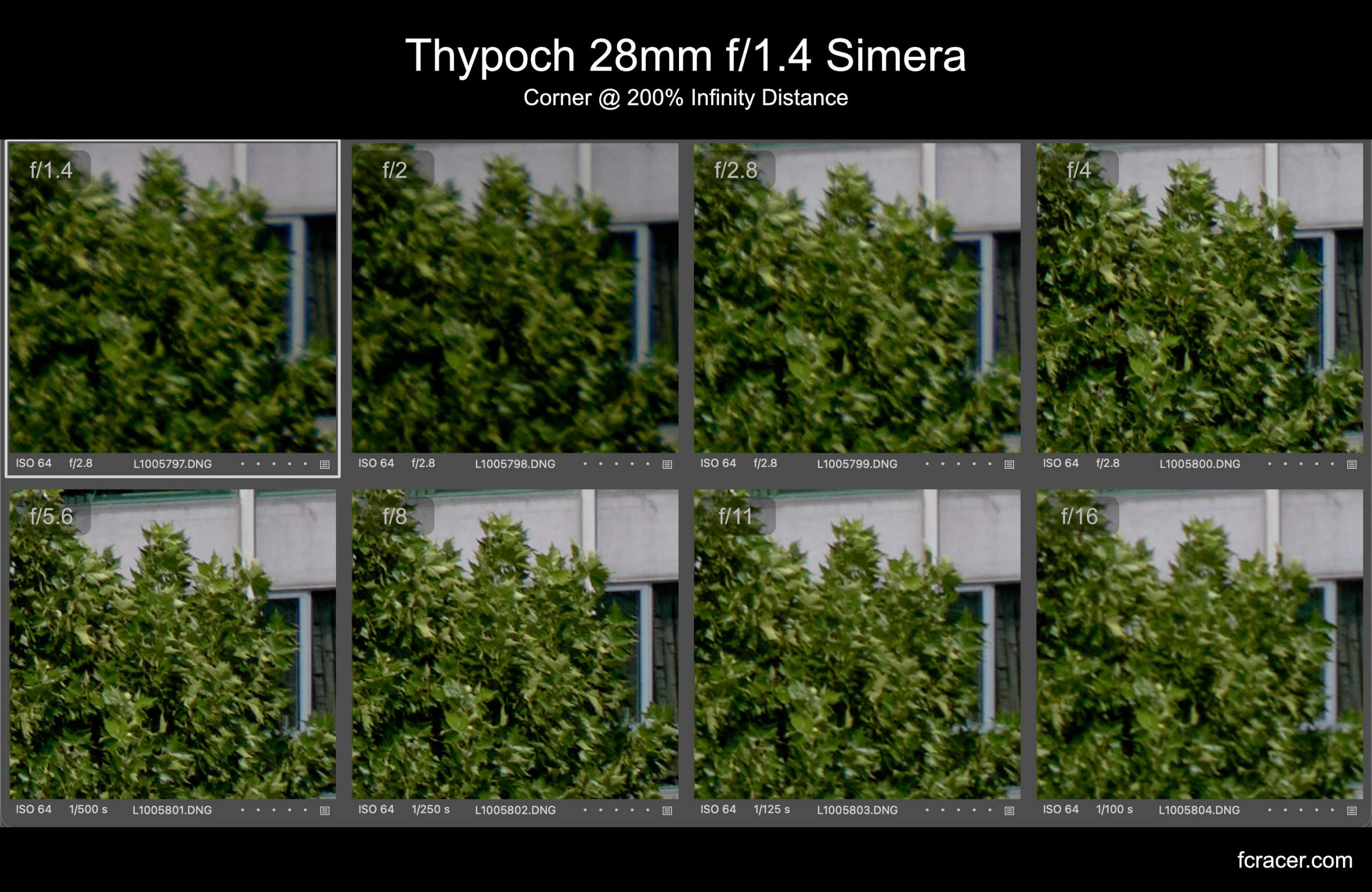
In the corners, it’s also the same story. Sharpness is good at f/1.4, gets very good at f/4 and then ramps up to excellent between f/8 and f/11. At f/16, diffraction comes into play and softens the image.
Summary
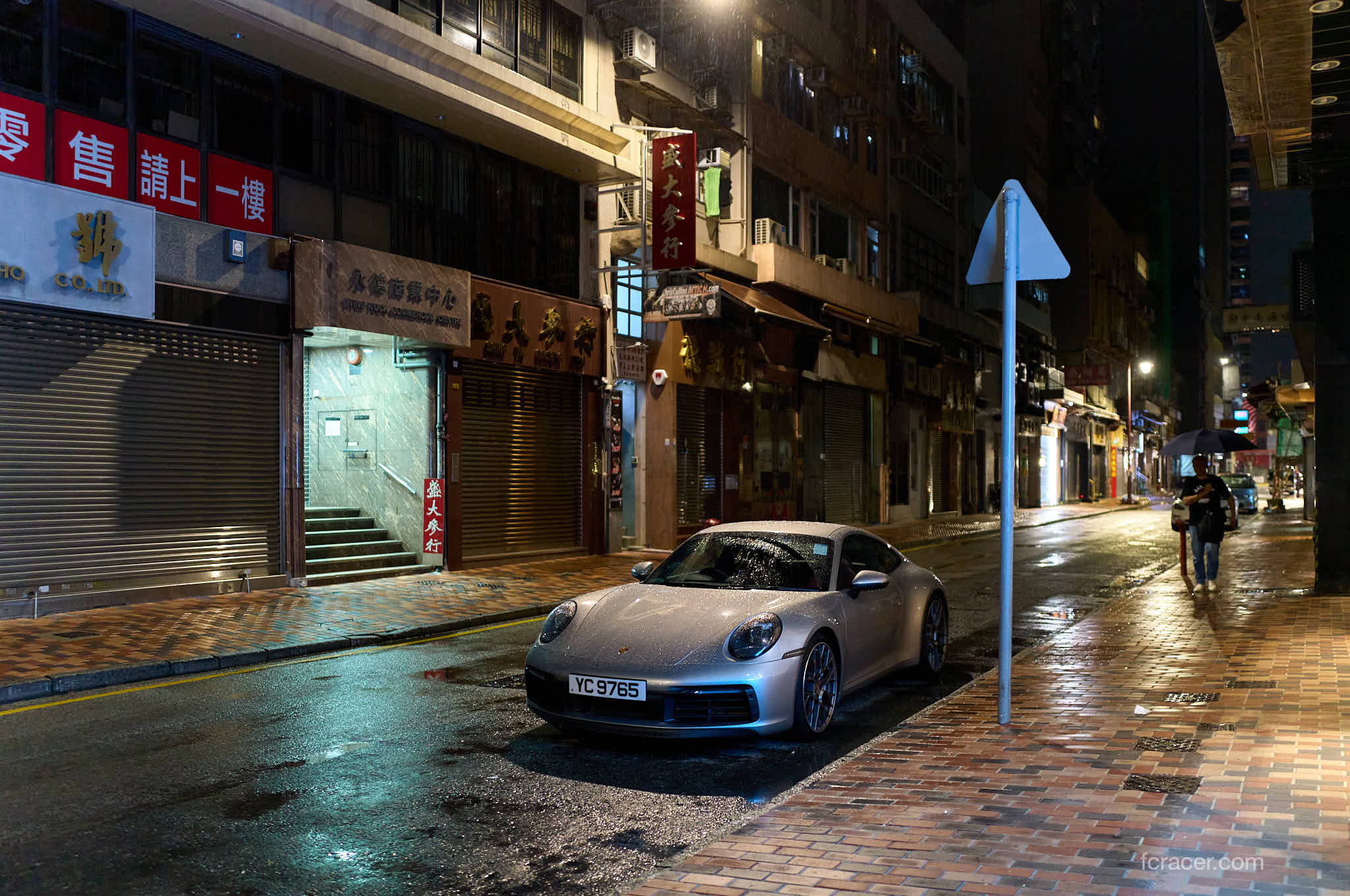
Overall, this is an excellent result for this tiny lens. Prior to running the test, I’d been using the lens every day, and was impressed with what I was seeing, so I knew it was going to produce strong results on the test chart, but I was still pleasantly surprised at how good it was. In every situation I threw at it, the images were sharp with excellent contrast. Even night images showed minimal aberrations and very high contrast.
Every lens is built around compromises and the engineers at Thypoch should be applauded for balancing the compromises perfectly with this lens. They gave us a small, light and sharp lens that produces beautiful images from f/1.4 through to f/11 and at all focus distances, whether it be at 0.3 m or at infinity.

Distortion & Aberrations
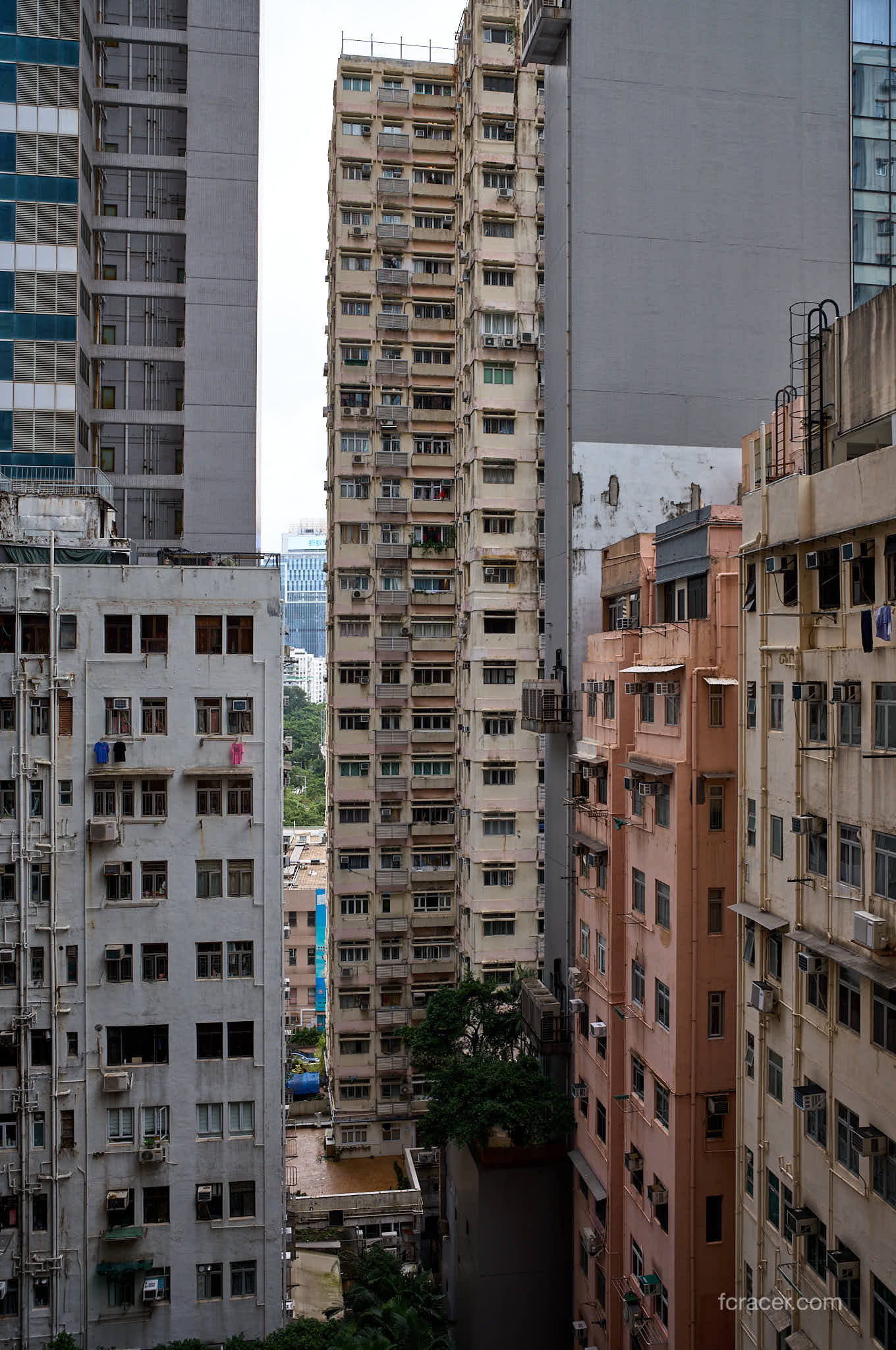
Distortions were minimal in my testing with a very slight moustache distortion visible at the Minimum Focus Distance. However, this never impacted any of the images or provided any cause for concern. Aberrations were also very well controlled with a very slight amount of green fringing visible in extreme high contrast edges. These were so minimal, and only visible at 200% or higher magnification, that I didn’t feel the need to apply any correction in the post processing software.
Bokeh
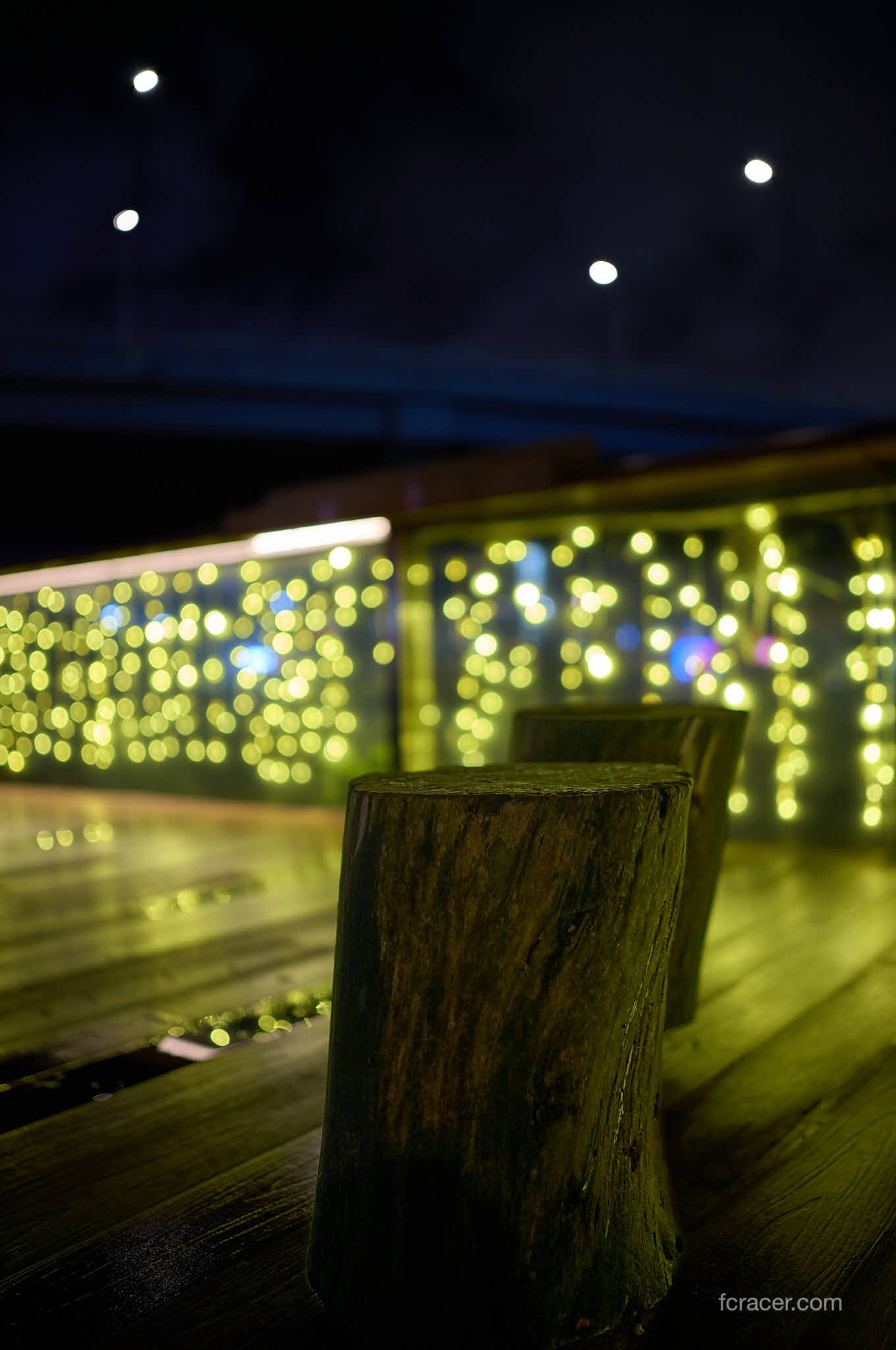
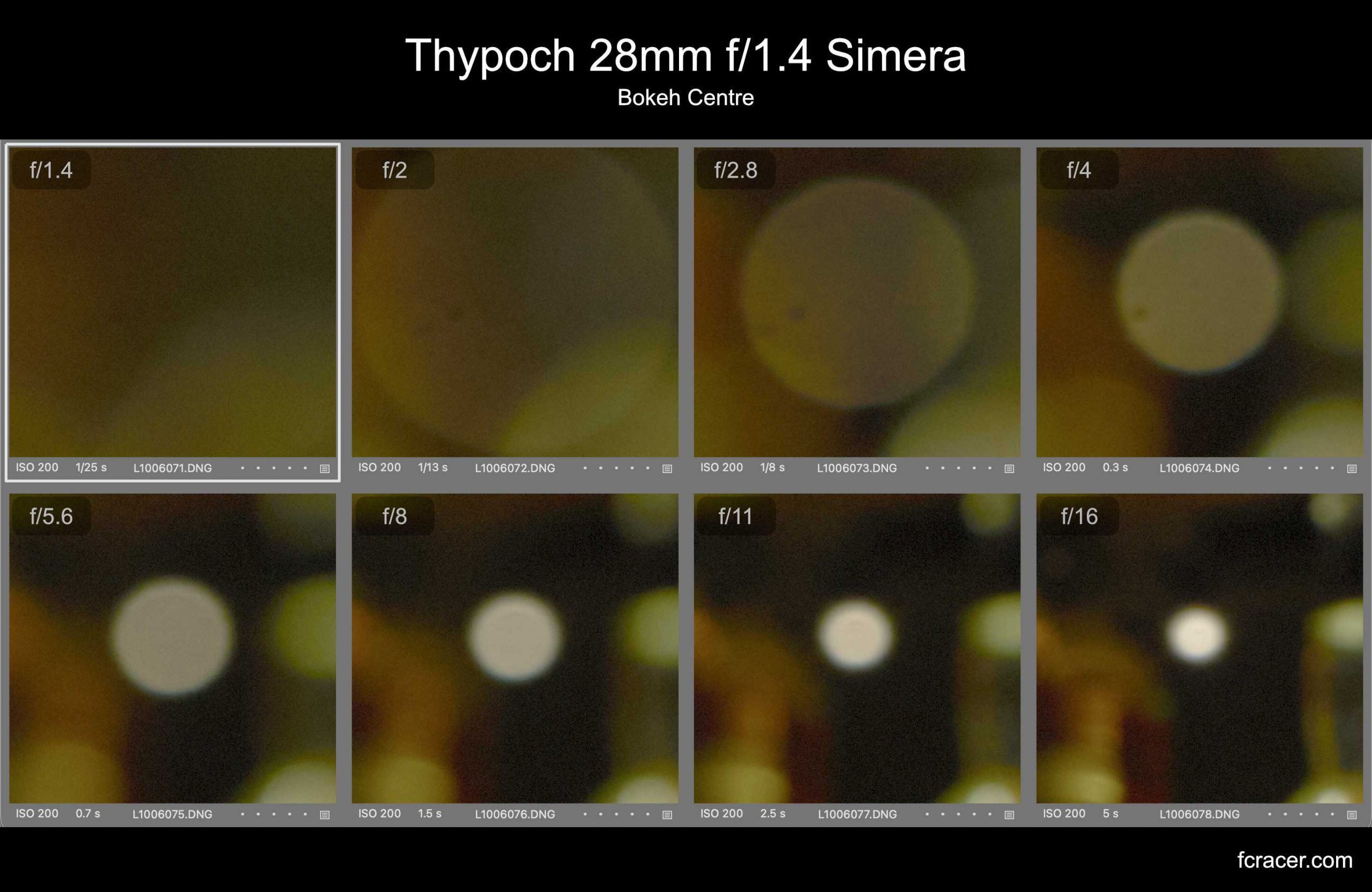
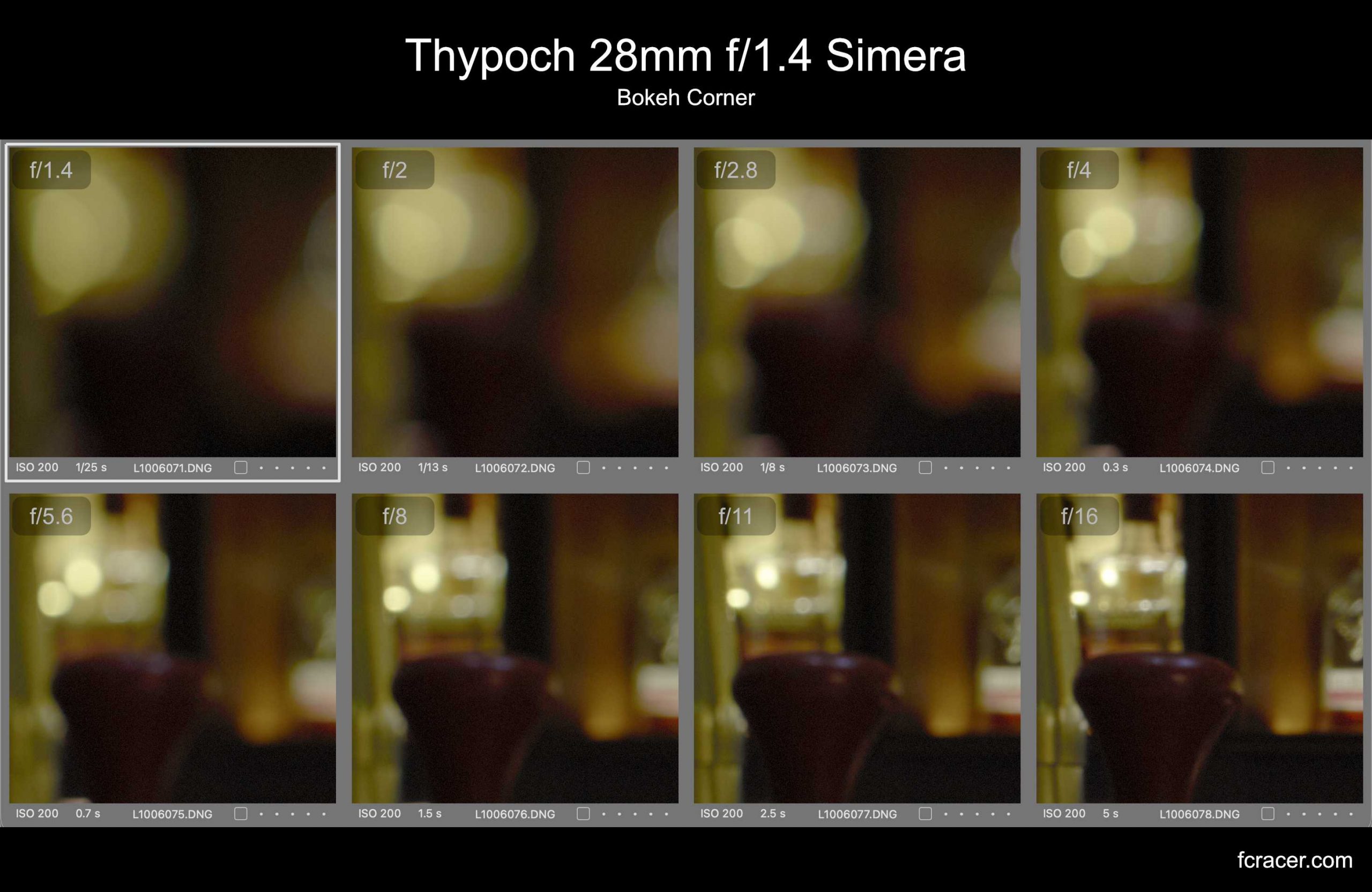
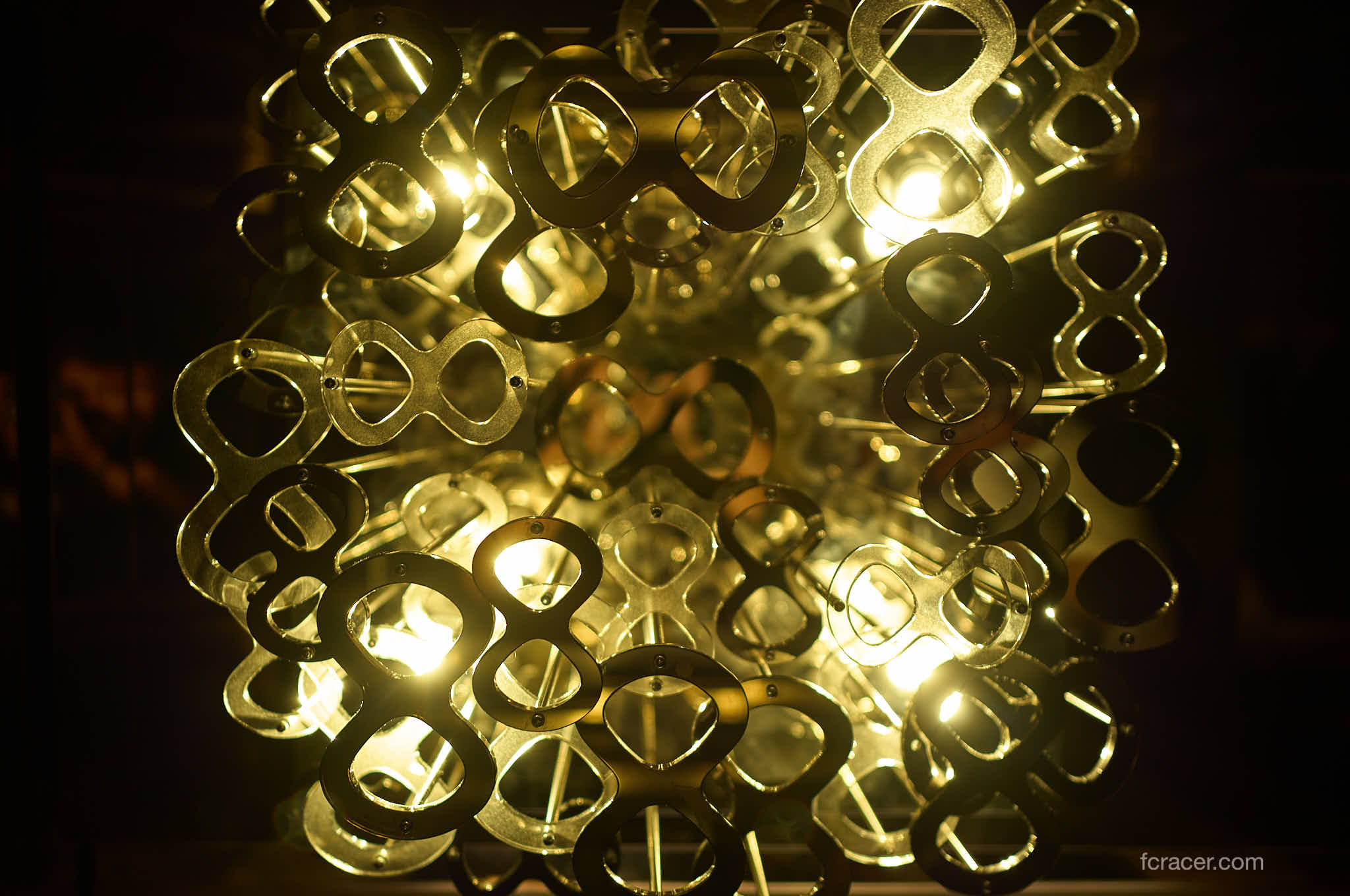
The Thypoch 28 mm excels in this area. It’s very apparent that the engineers prioritized bokeh as a key characteristic of this lens. It’s so creamy and beautiful, without any noticeable onion rings or other distracting aberrations. It’s so beautiful that I was tempted to shoot every image at f/1.4.
As we’d expect of a small wide-aperture lens, there’s some mechanical vignetting from f/1.4 to f/2, but it’s fairly minor and not distracting given the wide field of view. At f/2.8, the bokeh balls become perfectly round in the corners.
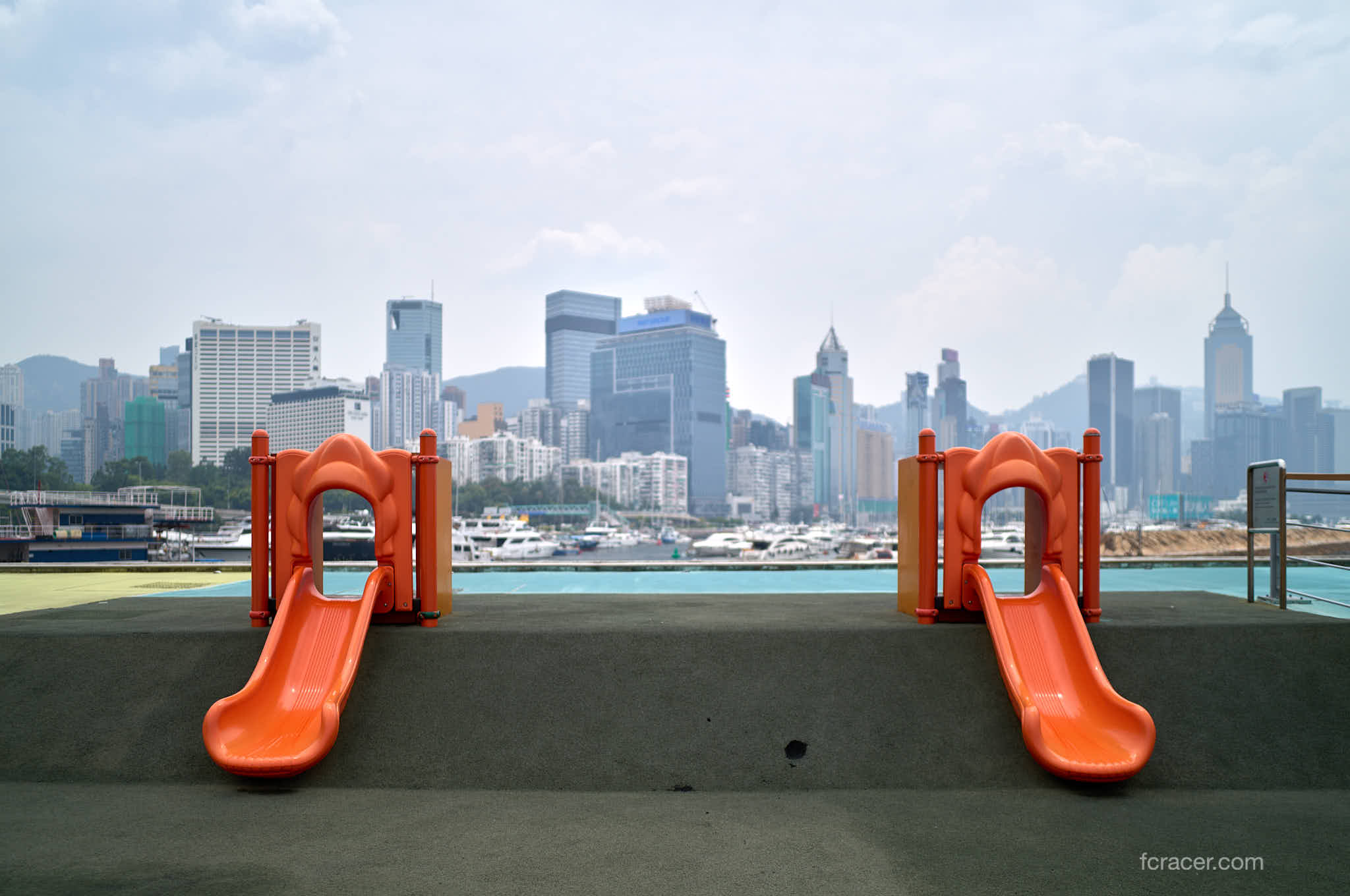
There’s something magical about a wide-angle, wide-aperture lens. It gives this three-dimensional effect to the image that it shouldn’t have, given the wide field of view. To many people, this is what makes medium-format film cameras so special; they can produce an image with a wide angle and a shallow depth of field.

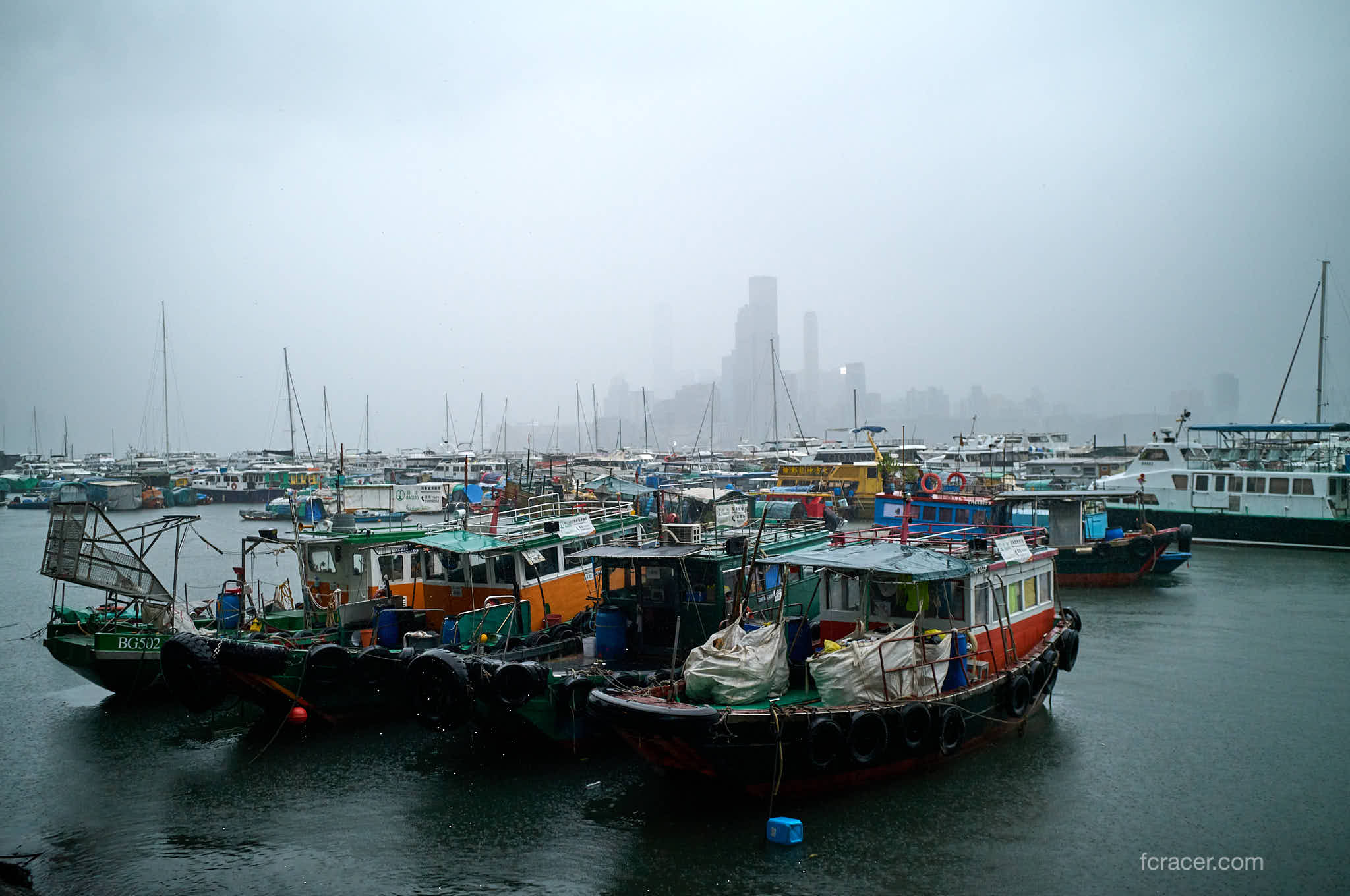
To have this shallow depth of field in a tiny lens, mounted to a tiny M11 camera, makes for a very special image-making combination. Add onto that the MFD of 0.3 m and you can create some serious bokeh. Below are a series of test images taken at 30 cm which goes to show how sharp the lens is and how creamy the bokeh is. Absolutely fantastic result!








Focus Shift
I tested the Thypoch 28 mm at 1 m, 2 m, and infinity and at f/1.4, f/4, and f/11 and found there to be no apparent focus shift. Every image achieved the same level of sharpness regardless of whether I used the optical rangefinder or the LCD with focus peaking.

Usability
The lens exudes quality and encourages you to manipulate the aperture and focus dials just to feel how well they’re designed. There’s however a cool party trick that Thypoch has included in this lens, a zone focus range indicator. Rather than using lines, Thypoch included little dots that light up in red paint to show what will be in usable focus.
This is especially useful in wide-angle lenses where, even at 61MP, when using f/8, you can get everything in sharp focus. While I found this a very cool feature, it would be better executed if the dots were in white as the red was hard to see in anything but bright lighting.
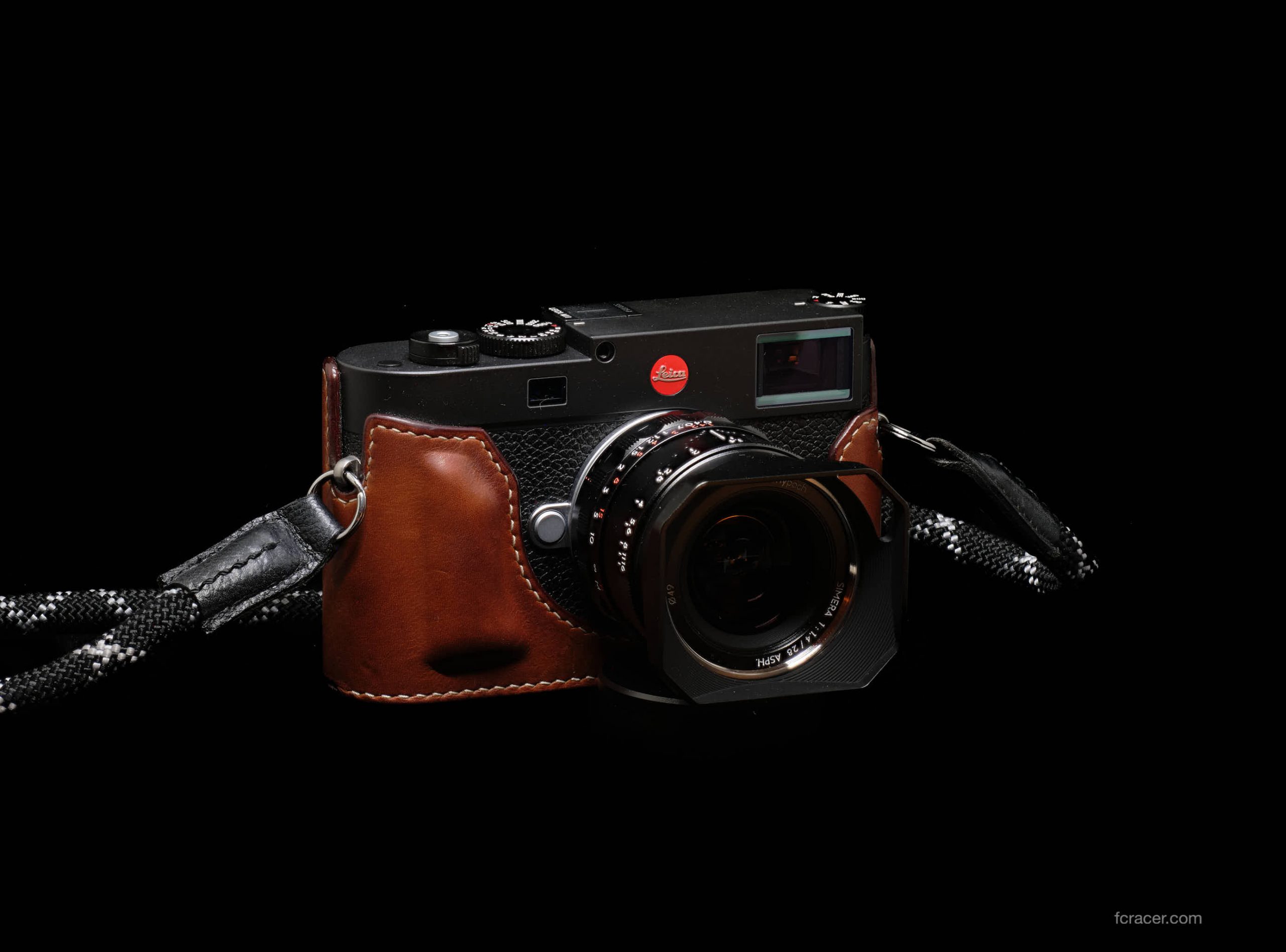
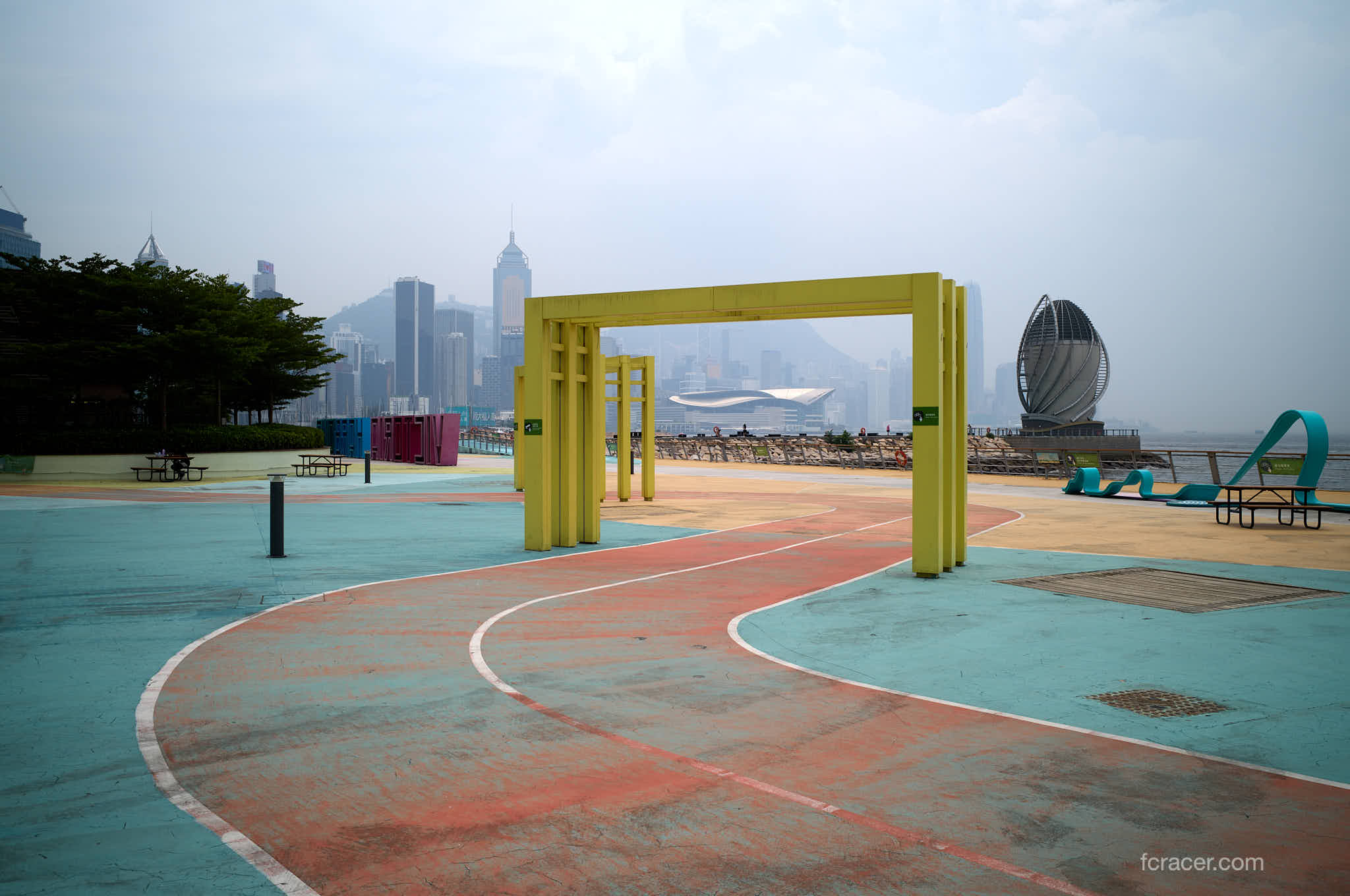
The wide angle and aperture allowed me to use the lens in a large variety of circumstances, from bright sunny days to dark nightscapes. It’s a very versatile lens that can go anywhere and do anything. With the Leica M11’s high-resolution sensor, the wide-angle lens can be used as a “one and done”, with digital cropping enabling field of view adjustments in post-processing. There’s a reason why Leica chose the 28 mm field of view for their bestselling Leica Q.

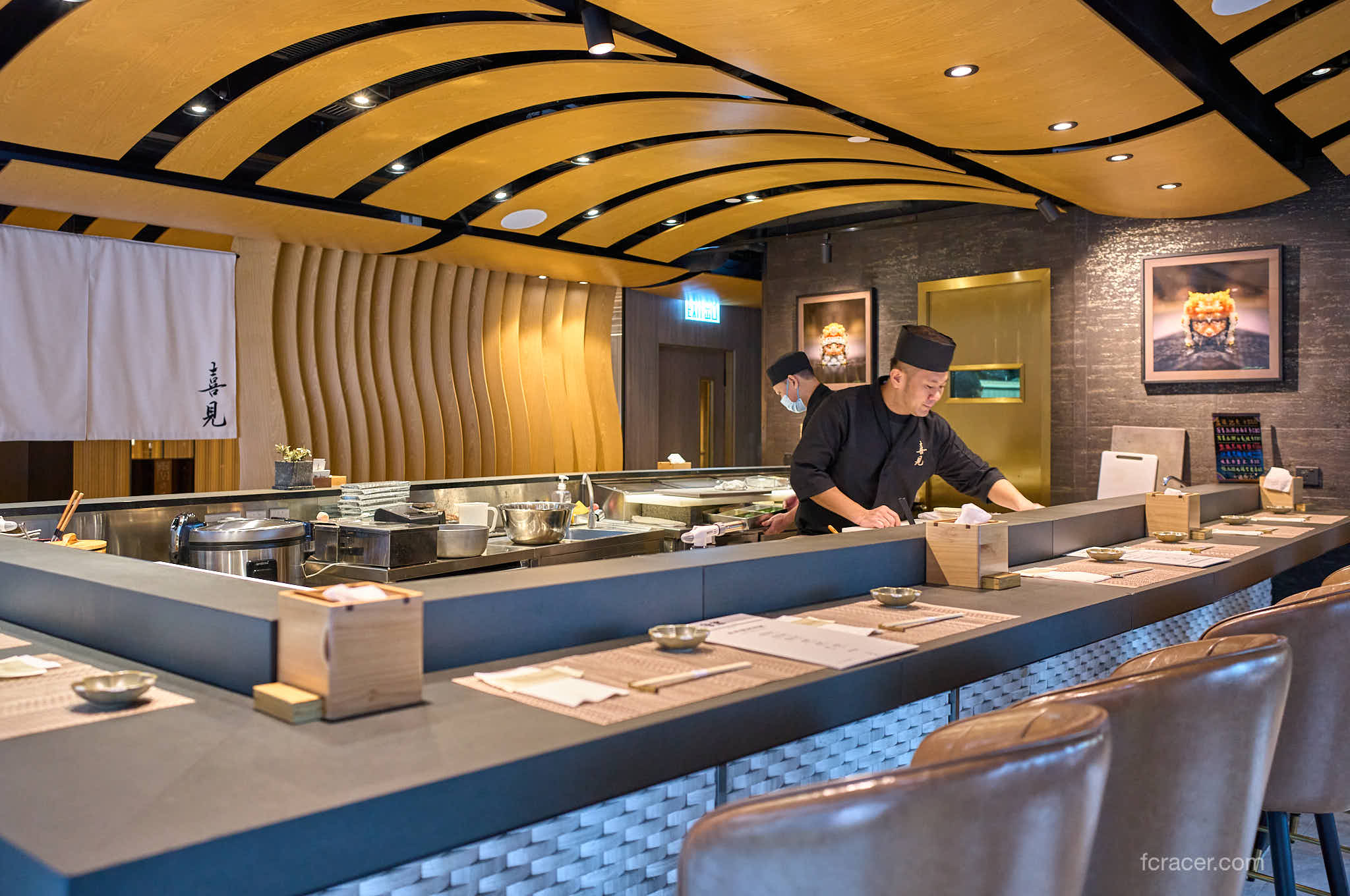
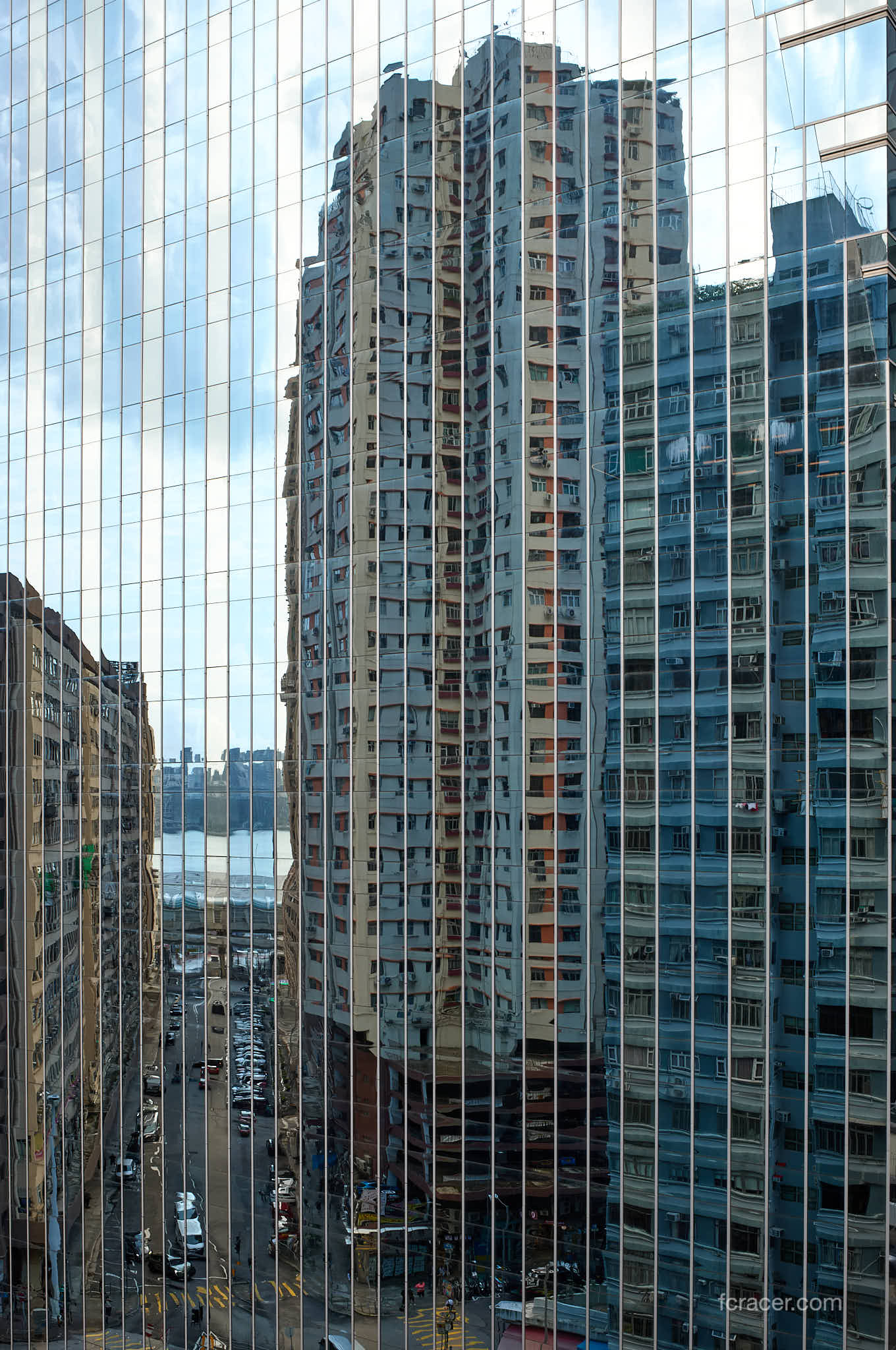
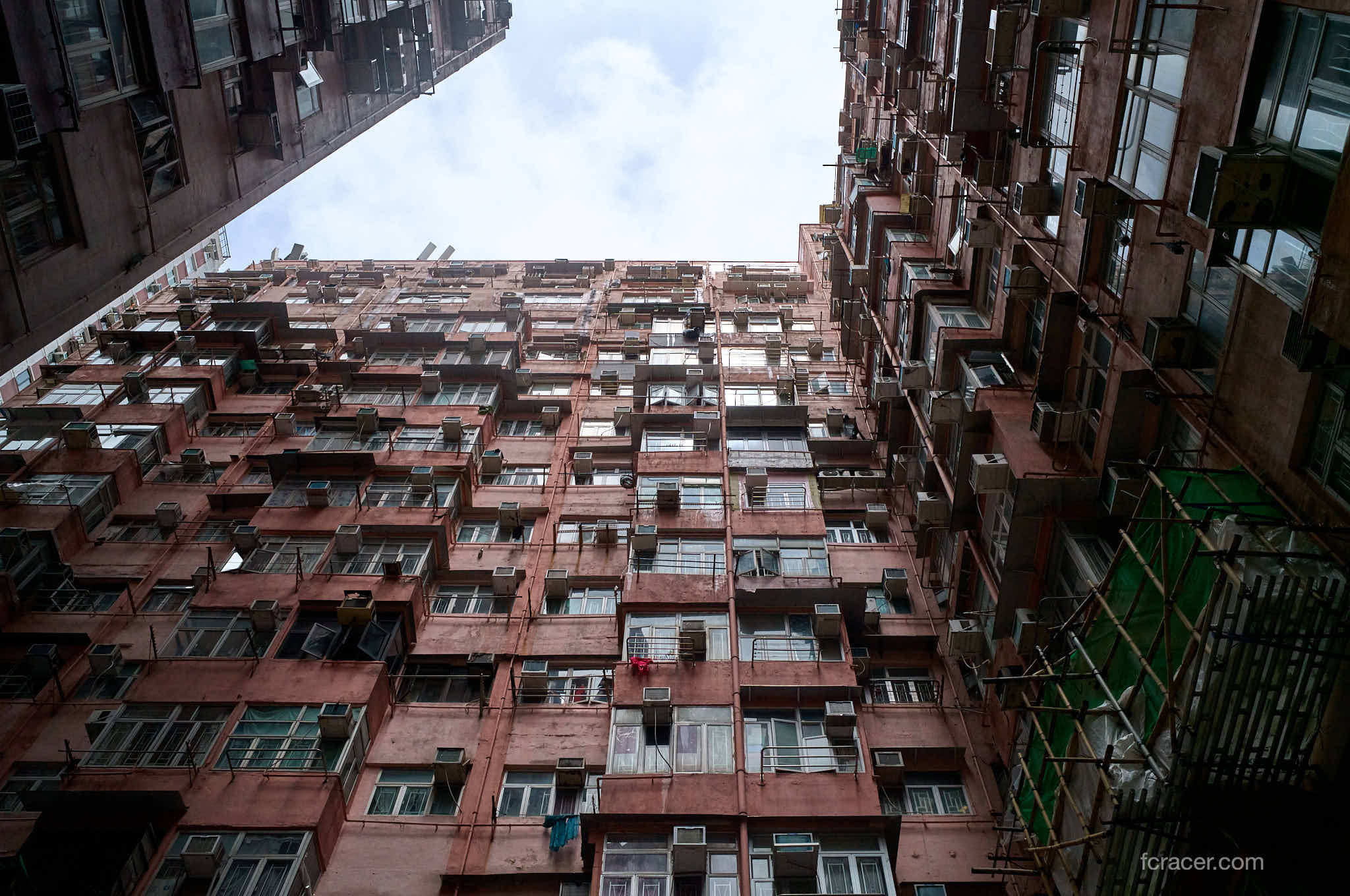
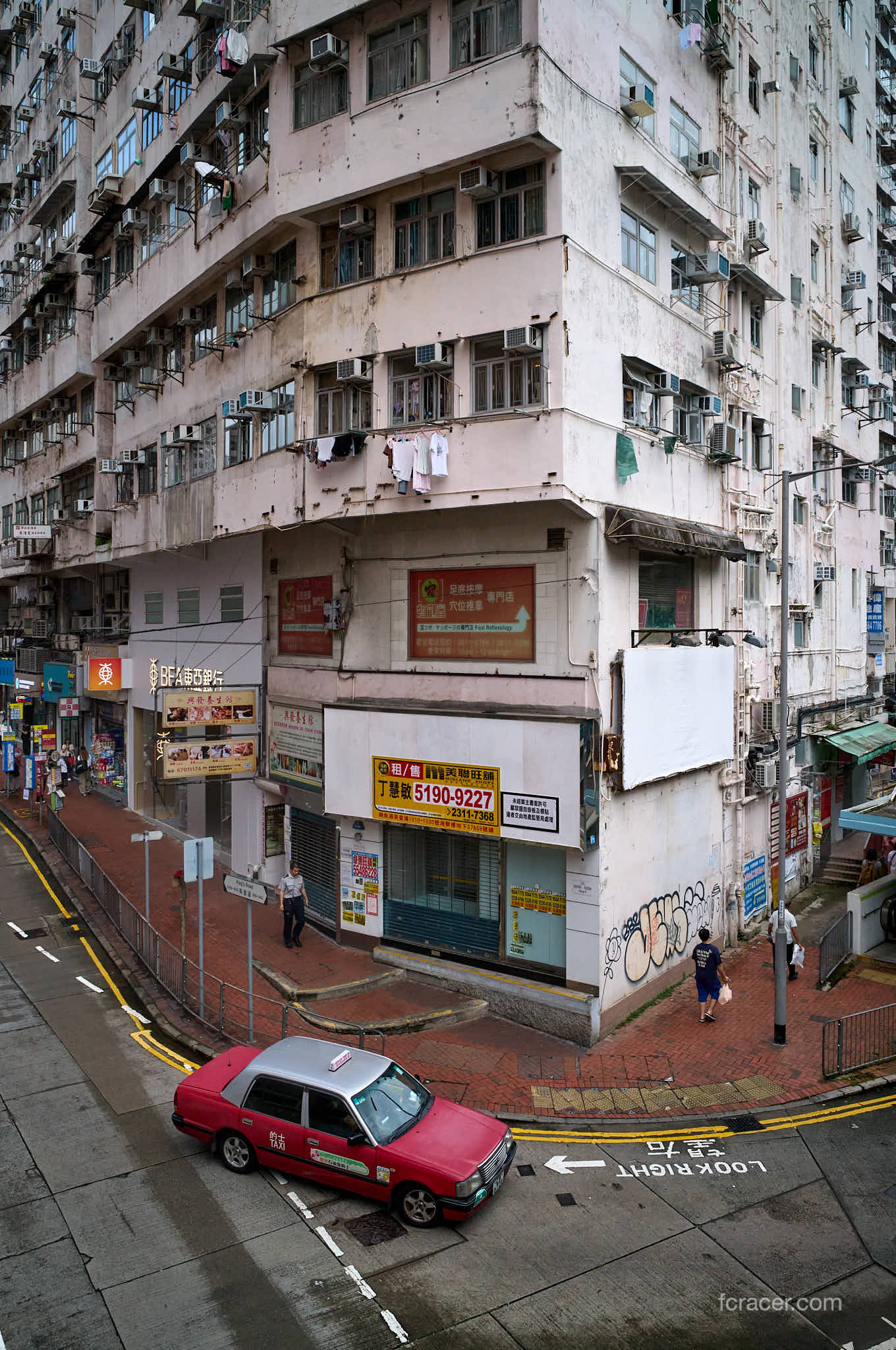
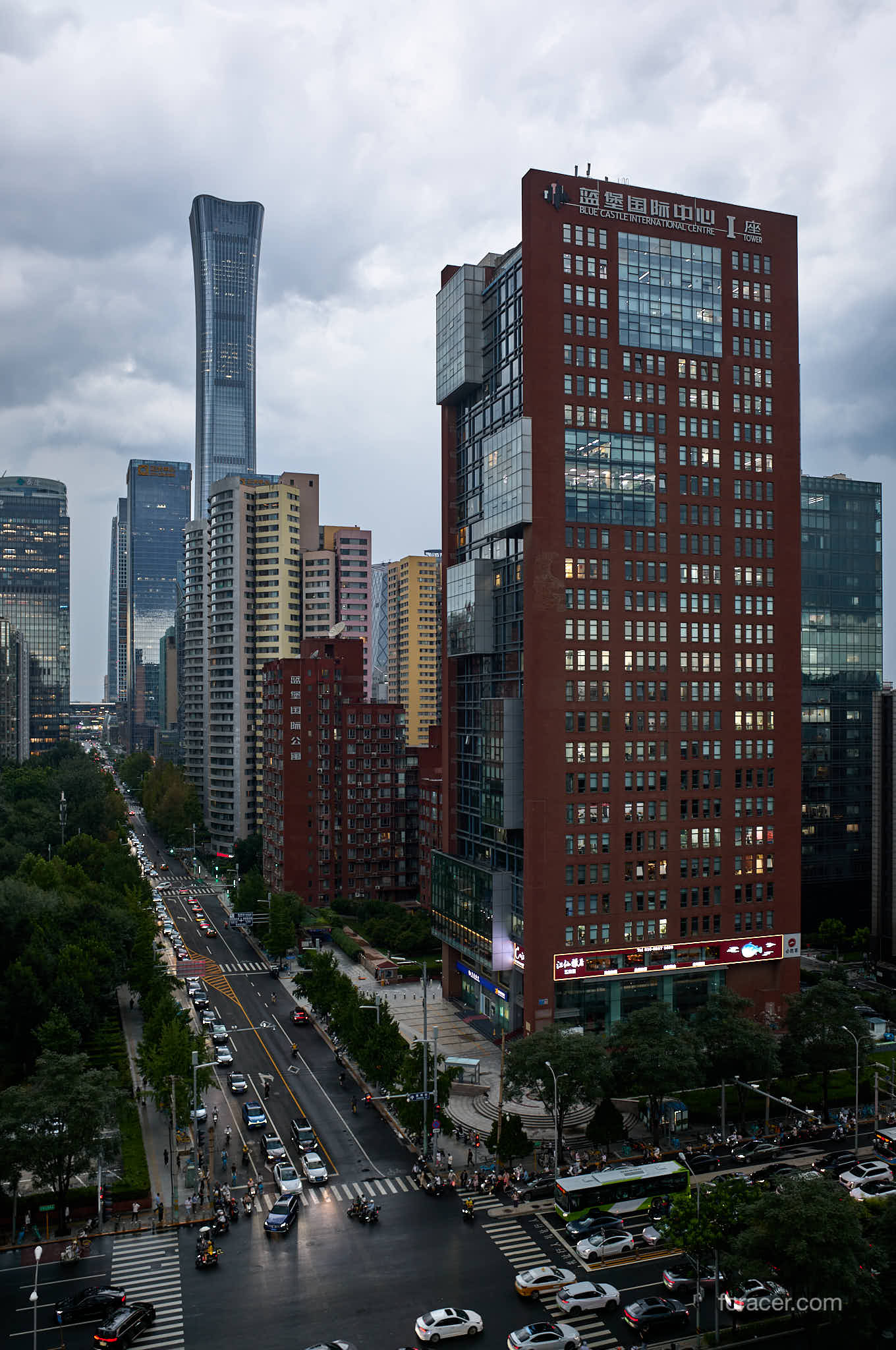
During the test period, I found this lens glued to the camera. It was the ideal lens for almost every occasion, especially with the 0.3 m MFD. I could take close-up images of food for posting on social media, images from friends in social settings, and architecture or streetscapes. I forgot how versatile 28 mm could be!
Thypoch, the Company
While reviewing the Thypoch 28 mm, I purposely didn’t do any research into the company. I wanted to be completely unbiased; however, as I used the lens, it became apparent that there were very passionate and experienced people behind the design of this lens. I started to do some research and found out that Thypoch is owned by DZ Optics Group, a purveyor of cinema and machine learning lenses.
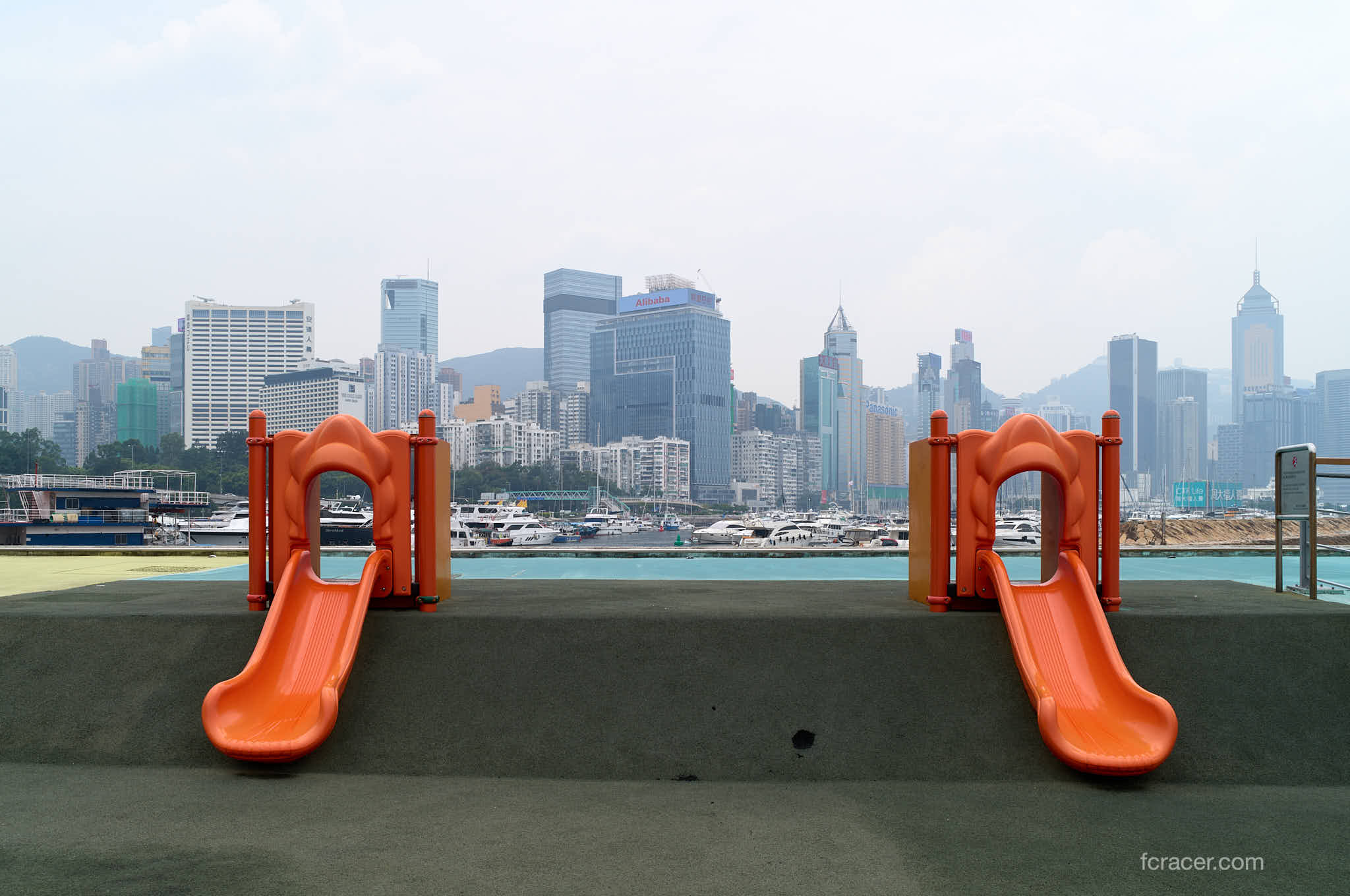
That’s when it all clicked. There’s a maturity in product design that comes across from this lens that demonstrates it’s not from a startup company or someone new to the field. These folks have a depth of experience that comes across in the optical quality, luxurious haptics, and the feeling of perfect build quality. After this experience, I’m now intrigued to try their other offerings to see if they’re consistent with the excellence I experienced with the Thypoch 28 mm.
Thypoch is located in Shenzhen, China, and I’m hoping to visit their production facility in the future given I spend a lot of time in Hong Kong. If the opportunity comes up, I’ll be sure to publish a post of what it’s like inside their facility. I’m keen to meet the people behind this lens; I can feel their passion in every decision they made.

Conclusion
The Thypoch 28 mm is an excellent wide-angle, wide-aperture prime lens. It’s a lens that can be trusted to deliver, no matter the situation. It can be used wide open without worrying about aberrations or sharpness, and it can be stopped down to produce razor-sharp images across the image plane.
The only question that came to my mind was about aftersales service. What happens if there’s a defect or some random issues were to come up? Fortunately, with DZ Optics being their parent company, that fear was alleviated. In my conversations with the company, I found people with a relentless desire to make improvements.
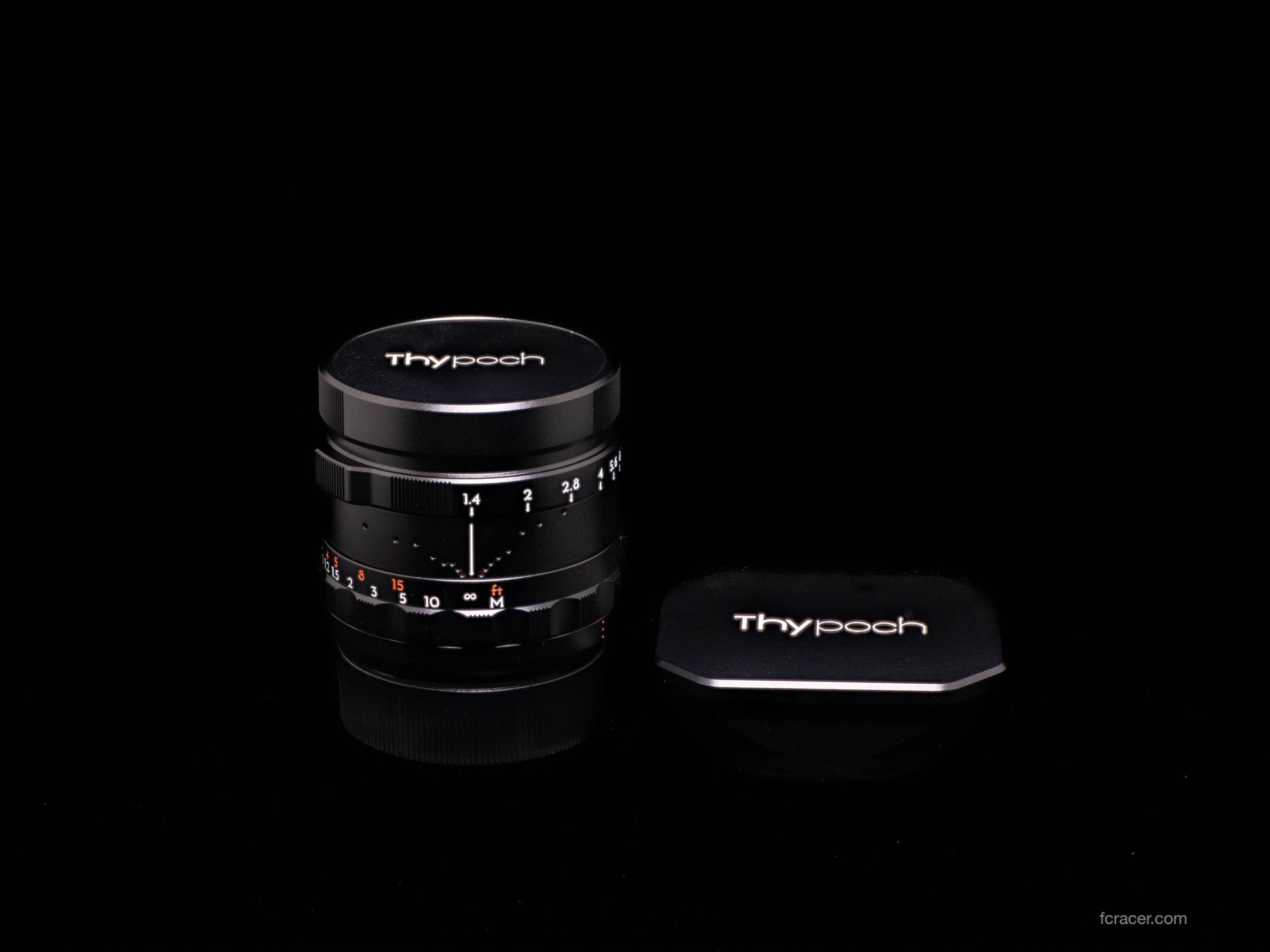
When I mentioned the hood having less-than-ideal haptics on how it goes on and off, the Thypoch folks provided that feedback to their engineering team, who in turn worked on improving the mechanism for future production runs. I love a company that listens to its clients and takes quick actions. Based on my experience using the lens and my interactions with the company, I can highly recommend the Thypoch 28 mm.
There’s a tremendous amount of value in this lens at USD 699. Thypoch is leaving money on the table at this price, but it shows their determination to make a strong statement in this space. I would imagine price increases coming in the future when their brand is better known. There’s no reason why this lens should be priced lower than the USD 999–1,049 Voigtländer competitor.

I hope that you’ve found this review helpful. If you have any questions, please let me know in the comments below. Given the high performance of this lens on the Leica M11, I’m tempted to give it a try on the Sony A7R5 or even the Fujifilm GFX100S II. If there’s interest in that, please let me know and I can conduct test chart runs with those cameras and publish it in a follow-up post.










Thypoch Simera 28 mm f/1.4
USD 699
Pros
- Excellent Build Quality
- Excellent Optical Performance
- Very Good Value for Money
Cons
- Lens Hood Lacks Lock
Discover more from fcracer - Travel & Photography
Subscribe to get the latest posts sent to your email.
Great article, Farz! Enlightening for me as I had little knowledge of this brand before reading. I found the 28mm focal length took me a long time to get used to -i had one for my film Nikon and sold it not long after a few half-hearted attempts to shoot with it. That said, having used the Ricoh GRiii, with it’s fixed 28mm, as the more readily at hand companion to my M10R, I’ve grown quite accustomed to that focal length now. I’m not likely to add a 28mm M-mount lens given the Ricoh is always in the pocket, however, your encouraging comments on Thypoch build quality have me considering their Simera 75mm for the Leica…